
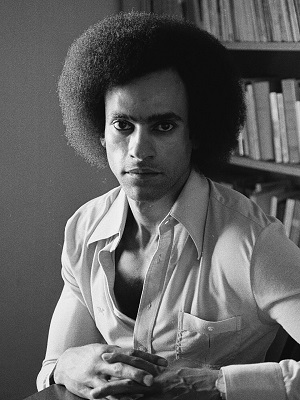
Huey P. Newton


February 17 …
Huey P. Newton — Huey Percy Newton — was born on February 17, 1942, in Monroe, LA and moved with his family to Oakland, CA during the second wave of the Great Migration.
Growing up in a poor, but politically conscious household, Newton witnessed the brutal effects of racism, poverty, and police violence on Black communities. He struggled in school, in part due to systemic neglect, but eventually taught himself to read fluently by studying classic works of philosophy and political theory. This intellectual awakening marked the beginning of Newton’s transformation from a disenfranchised youth into a radical thinker and leader.
In 1966, alongside fellow activist Bobby Seale, Newton co-founded the Black Panther Party for Self-Defense. The organization began as a direct response to the routine police brutality that plagued Black neighborhoods in Oakland. Newton developed the party’s guiding ten-point program, a bold declaration of demands centered on justice, housing, education, and an end to police violence.
The Panthers quickly became a symbol of resistance, with Newton’s vision at the ideological core. His study of revolutionary theory — from Marx and Lenin to Malcolm X — informed the party’s unique synthesis of armed self-defense and social reform.
Newton’s leadership style was both fearless and intellectual. He believed in the power of community control and the necessity of standing up to oppressive systems through organized action. Under his guidance, the Panthers initiated numerous community service programs, including free breakfasts for school children, medical clinics, and educational programs. These efforts helped redefine the party’s image from militant to humanitarian, though the media and law enforcement often continued to portray the group as dangerous radicals. Newton, however, remained unwavering in his belief that true change required both radical resistance and a reimagining of social structures.
His activism made him a primary target of law enforcement, particularly through the FBI’s COINTELPRO operation, which sought to dismantle Black radical movements.
In 1967, Newton was arrested and charged with the murder of a police officer during a traffic stop. His trial became a national cause, sparking the “Free Huey” campaign and galvanizing support from activists and intellectuals across the country. Although Newton was eventually released after a retrial, the years of legal battles, surveillance, and internal party tensions began to take a toll on both him and the organization.
Throughout the 1970s, Newton’s role in the Black Panther Party became more complex. He pursued a doctorate in social philosophy at the University of California, Santa Cruz, seeking to further explore the intersection of theory and activism. At the same time, internal conflicts, government pressure, and personal struggles — including accusations of violence and substance abuse — began to cloud his leadership. The party slowly dissolved, and Newton’s once revolutionary image grew more complicated in the public eye. Still, he remained deeply engaged in issues of justice, inequality, and Black empowerment.
Newton’s life ended tragically on August 22, 1989, when he was fatally shot in Oakland. Though his later years were marked by turmoil, his legacy as a revolutionary thinker and fearless advocate for Black liberation continues to resonate.
Huey P. Newton fundamentally altered the way Black communities saw themselves and how they confronted oppression. His intellect, passion, and uncompromising pursuit of justice helped shape one of the most influential movements in American history — one that still inspires the fight for dignity and equality today.