
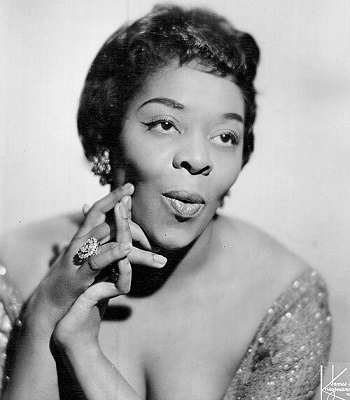
Dinah Washington

August 29 …
Dinah Washington stands as one of the most commanding and versatile vocalists in twentieth-century American music, a singer whose artistry bridged jazz, blues, gospel, and pop while reshaping the possibilities for Black women in entertainment.
Born Ruth Lee Jones on August 29, 1924 in Tuscaloosa, AL and raised in Chicago, Washington grew up in a devout household where gospel music laid the foundation for her early training. Singing in church choirs, playing piano, and winning amateur contests as a teenager, she developed a disciplined musicianship that combined sacred fervor with a keen rhythmic instinct. Although she didn’t pursue extensive formal higher education, her musical education was rigorous, deeply rooted in the Black church, local clubs, and the vibrant South Side scene that shaped modern jazz and blues.
Her professional breakthrough occurred in the mid-1940s when vibraphonist and bandleader Lionel Hampton heard her perform and invited her to join his orchestra, where she adopted the stage name Dinah Washington. Under Hampton’s mentorship, she honed her phrasing and stage presence, learning to command large audiences with precision and charm.
Drawing inspiration from blues legend Bessie Smith and jazz innovator Billie Holiday, she crafted a vocal identity that was leaner and more rhythmically incisive. Her delivery &mdahs; marked by crisp diction, emotional directness, and impeccable timing &mdahs; allowed her to excel in both smoky blues numbers and sophisticated big-band arrangements.
By the 1950s, Washington had become one of the most recorded and commercially successful Black female artists in America. Her work with Mercury Records produced an impressive series of R&B hits and crossover successes, culminating in the 1959 pop triumph “What a Diff’rence a Day Makes.” This recording earned her a Grammy at the inaugural Grammy Awards ceremony, solidifying her mainstream appeal during a time when racial barriers constrained many Black performers. She graced major venues such as the Apollo Theater and participated in events like the Newport Jazz Festival, helping elevate jazz and blues from regional traditions to nationally celebrated art forms.
Washington’s influence extended profoundly into gospel and soul traditions. While secular fame characterized her career, her roots in church music connected her to artists like Mahalia Jackson, whose spiritual intensity mirrored Washington’s emotional clarity.
Among her contemporaries were jazz greats Sarah Vaughan and Ella Fitzgerald, who each expanded vocal jazz in their own distinct ways, while bandleaders such as Count Basie shaped the broader swing landscape she navigated. Washington also collaborated with and influenced emerging talents, including a young Quincy Jones, and her stylistic impact resonates in later icons like Aretha Franklin, who echoed Washington’s combination of church-rooted power and worldly sophistication.
Beyond her chart success, Washington made significant contributions to American cultural history by asserting her artistic autonomy and commanding respect in a male-dominated industry. Often referred to as the “Queen of the Blues,” she was unapologetically professional, insisting on high standards from musicians and promoters alike.
Washington’s diverse repertoire — spanning torch songs, blues laments, and polished pop ballads — helped dismantle rigid genre boundaries, paving the way for modern soul and R&B vocalists.
Although her life was tragically cut short in 1963, the legacy of Dinah Washington endures through posthumous honors, including induction into the Rock and Roll Hall of Fame, and through the generations of singers who continue to draw inspiration from her clarity, courage, and interpretive brilliance as a paragon of American musical excellence.
