
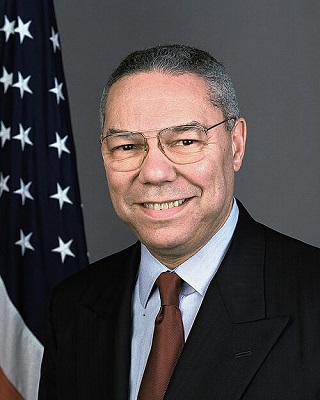
Colin Powell


April 5 …
Colin Powell was a soldier–statesman whose career bridged the highest levels of American military command and diplomatic leadership, shaping U.S. government, politics, and global strategy at the turn of the 21st century.
Born on April 5, 1937 in Harlem, NY to Jamaican immigrant parents, Powell was raised in a working-class community in the South Bronx that instilled the values of discipline, faith, and education. He graduated from the City College of New York, where he became involved in the Reserve Officers’ Training Corps (ROTC), ultimately discovering his true calling in the military rather than in his original academic pursuits.
Guided by mentors within ROTC and inspired by professional soldiers who prioritized service above self, Powell began a career that would take him from the battlefields of Vietnam to the Cabinet room of the White House.
Powell’s two tours in Vietnam significantly influenced his perspectives on military engagement and political accountability. As he advanced through the ranks, he gained a reputation for his organizational prowess, calmness under pressure, and ability to navigate complex bureaucracies.
In 1987, he was appointed National Security Advisor under President Ronald Reagan, playing a pivotal role in shaping U.S. foreign policy during the last years of the Cold War. Two years later, under President George H.W. Bush, he became Chairman of the Joint Chiefs of Staff, making history as the youngest officer and the first African American to occupy the position.
As Chairman, he oversaw U.S. military operations during the invasion of Panama and the Gulf War, articulating the “Powell Doctrine,” which prioritized clear objectives, overwhelming force, and public support before deploying American troops into combat. He collaborated with leaders such as President Bush and worked across party lines, establishing a reputation for pragmatism and steady leadership. His approach to civil-military relations was partly informed by lessons from Vietnam and by senior officers who emphasized professionalism and restraint.
Powell admired leaders who combined moral clarity with strategic patience, striving to embody these qualities in his decision-making. His prominence as a four-star general also held significant cultural implications, challenging perceptions of African American leadership in institutions historically marked by exclusion. Alongside other influential figures in public service, he became a symbol of increasing opportunity within the American establishment.
In 2001, Powell returned to the public sphere as Secretary of State under President George W. Bush, making history as the first African American to hold the nation’s highest diplomatic position. As the U.S. faced the aftermath of the September 11 attacks and the subsequent global war on terror, he represented the country on the world stage, championing coalition-building and multilateral collaboration.
Powell’s 2003 address to the United Nations regarding Iraq’s alleged weapons programs became one of the most scrutinized moments of his career, highlighting the immense pressures and controversies of the time. Despite political divisions, Powell was widely respected for his honesty, later expressing regret over intelligence failures related to the Iraq War, a position that underlined his commitment to accountability in public service.
Over his lifetime, Powell received numerous accolades, including the Presidential Medal of Freedom (awarded twice), Congressional Gold Medal, Defense Distinguished Service Medal, and various military decorations recognizing his valor and distinguished leadership.
After his government service, he devoted himself to educational initiatives, youth mentorship, and nonprofit work, emphasizing character development and civic responsibility. His autobiography and public addresses reinforced themes of integrity, preparation, and inclusive patriotism.
When Colin Powell dies in 2021, tributes from across the political spectrum highlighted his unique place in American history: a leader who rose from humble beginnings to the highest echelons of power, leaving a lasting legacy on American government, military strategy, diplomatic practice, and the nation’s evolving narrative on leadership and service.