
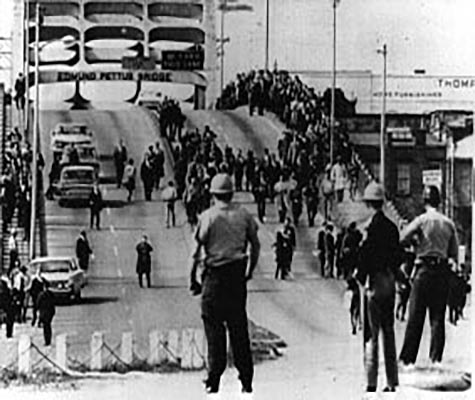
Bloody Sunday


March 7 …
Bloody Sunday, which occurred on March 7, 1965 in Selma, AL, was a pivotal moment in the American Civil Rights Movement.
On that day, a group of approximately 600 peaceful protesters, led by activists like John Lewis and Hosea Williams, attempted to march from Selma to Montgomery to demand voting rights for Black Americans. As they crossed the Edmund Pettus Bridge, they were met with violent resistance from state and local law enforcement officers, who used tear gas, clubs, and brute force to disperse the demonstrators. The brutal attack on peaceful protesters was broadcast nationwide, shocking the American public and igniting widespread outrage.
The events of that Sunday exposed the deep racial injustices faced by Black Americans, particularly in the South, and became a turning point in the struggle for voting rights. The violent response from authorities served to highlight the extreme measures being used to suppress Black political participation.
The image of peaceful protesters being beaten by law enforcement became a symbol of the violent opposition to civil rights reforms. In the wake of the attack, there was a groundswell of support for the movement, and protests and public demonstrations spread across the country.
In the aftermath of that Sunday, the movement gained significant momentum. On March 21, under federal protection, Dr. Martin Luther King Jr. led a second, larger march from Selma to Montgomery, with thousands of supporters joining the effort. Just a few months later, the Voting Rights Act of 1965 was signed into law by President Lyndon B. Johnson, a monumental victory for the civil rights movement.
Bloody Sunday remains one of the most significant events in the fight for racial equality, symbolizing both the violence faced by activists and the power of their resistance in effecting lasting change.