
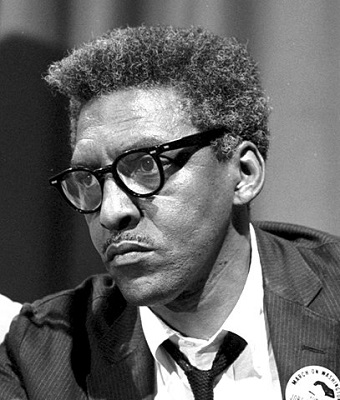
Bayard Rustin


March 17 …
Bayard Rustin was a pivotal figure in the American Civil Rights Movement, best known for his role in organizing the 1963 March on Washington for Jobs and Freedom, which remains one of the most significant events in the fight for racial equality.
Born on March 17, 1912, in West Chester, PA, Rustin grew up in a Quaker household that influenced his commitment to nonviolence and social justice. His upbringing, coupled with his exposure to progressive ideals, guided him toward a life of activism, and by the time he reached adulthood, he had already begun his involvement in organizing for civil rights, labor rights, and anti-colonial movements.
Rustin’s early activism was shaped by his belief in nonviolent resistance, a philosophy that he would later help to refine within the Civil Rights Movement. He became a key strategist for leaders like A. Philip Randolph, whom he worked alongside in organizing the Brotherhood of Sleeping Car Porters.
Rustin’s political ideology was influenced by his experiences with pacifism, and he was a lifelong advocate for nonviolent protest as a tool for social change. His ability to remain committed to peaceful resistance, even in the face of intense opposition, was one of the reasons why he became a respected leader in the movement.
Despite his crucial contributions, Rustin’s openly gay identity was often a source of tension within the Civil Rights Movement, particularly among those who feared that his sexual orientation would detract from the movement’s broader goals. As a result, Rustin’s role in the movement was often downplayed or overlooked by mainstream civil rights leaders. However, his influence was undeniable, and he worked tirelessly behind the scenes to support civil rights causes, including organizing protests, drafting speeches, and advising leaders like Martin Luther King Jr. Rustin’s intersectional identity as both a Black man and a gay individual would later become an important part of his legacy, as he worked to bridge gaps between various social justice movements.
One of Rustin’s most significant achievements was his leadership in the planning and execution of the 1963 March On Washington. This massive event, attended by over 250,000 people, was a turning point in the Civil Rights Movement. Although Rustin was often overshadowed by other prominent leaders such as Dr. Martin Luther King Jr., it was Rustin’s organizational genius that made the march possible.
His meticulous planning, including coordinating transportation, permits, and logistics, ensured the success of the event. The March On Washington remains a landmark in the history of the movement, and Rustin’s behind-the-scenes work was instrumental in making it a reality.
Bayard Rustin’s legacy as a tireless advocate for civil rights, labor rights, and LGBTQ+ rights has gained greater recognition in recent years, as historians and activists have increasingly acknowledged his contributions to social justice. His work laid the groundwork for later movements that sought to address the intersectionality of race, class, and sexuality.
The ability of Bayard Rustin to persist in the face of personal and professional challenges demonstrates his resilience and unwavering commitment to creating a more just and equal society. His life serves as a reminder of the power of quiet leadership and the importance of staying true to one’s principles, even when faced with opposition from both within and outside of one’s community.
