
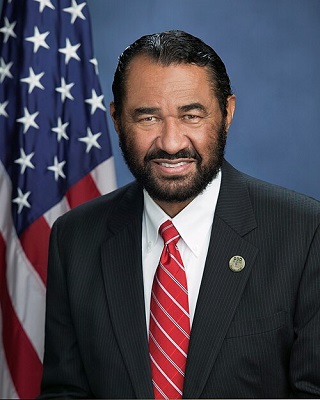
Al Green (Politician)


September 1 …
Al Green (Politician) is a longtime member of Congress whose work has focused on civil rights, economic justice, and the expansion of democratic protections in modern American society.
Born Alexander N. Green on September 1, 1947 in New Orleans and raised in Houston, TX, he grew up in the segregated South, which profoundly influenced his dedication to equality and public service. He attended Florida A&M University, Howard University, and Tuskegee Institute. He later obtained a law degree from Thurgood Marshall School of Law.
Early in his career, Green worked as an attorney and community advocate, focusing on combating discrimination and enhancing opportunities for underserved populations.
Green’s most notable achievements include serving as the U.S. Representative for Texas’s 9th congressional district since 2005, where he has championed legislation on fair housing, financial reform, and civil liberties. Before his tenure in Congress, he earned a reputation for fairness and accessibility while serving as a justice of the peace in Harris County, TX.
Influenced by civil rights icons like Martin Luther King Jr. and Thurgood Marshall, Green draws on their legal and moral frameworks to inform his approach to justice and equality. He stands alongside contemporaries such as Sheila Jackson Lee and John Lewis, who also prioritize civil rights and voting protections.
Green’s efforts have gained him recognition from organizations such as the NAACP, along with various community leadership awards for his advocacy on behalf of marginalized groups.
Green’s broader impact on American society is evidenced by his unwavering commitment to accountability and inclusion within government. Renowned for his principled stands on contentious issues, he has contributed to national discussions surrounding presidential power, economic inequality, and civil rights enforcement.
The career of Al Green (Politician) epitomizes the ongoing effort to align American democratic institutions with the principles of justice and equality, underscoring the necessity of continuous legislative and community action in shaping the nation’s narrative.