
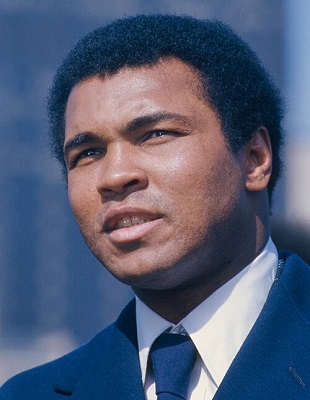
Muhammad Ali

January 17 …
Muhammad Ali — born Cassius Marcellus Clay Jr. on January 17, 1942 in Louisville, KY — is widely regarded as one of the greatest athletes and cultural figures of the 20th century.
His career in boxing was nothing short of extraordinary, with his unique combination of speed, agility, and brash confidence making him a household name across the globe. Ali won the World Heavyweight title three times and was renowned for his remarkable ability to “float like a butterfly, sting like a bee.”
His victories in the ring — particularly his battles with legendary opponents like Sonny Liston, Joe Frazier, and George Foreman — not only redefined the sport, but also changed the way athletes were perceived in American society.
Ali’s boxing career, however, was just one part of his larger-than-life persona. His brashness, self-assurance, and larger-than-life charisma made him a controversial figure from the start. He famously declared, “I am the greatest!” at a young age, earning both admiration and criticism.
Ali’s confidence and flair for public speaking were critical elements of his identity, and his refusal to adhere to the typical mold of athletes of his time pushed boundaries, particularly within the African American community. He was unapologetically bold in his approach, turning the boxing world and the broader public’s attention to his every move, whether it was in the ring or outside of it.
One of the defining moments of Ali’s career came in 1967, when he refused to be drafted into the Vietnam War. As a practicing Muslim and conscientious objector, Ali cited religious beliefs and opposition to the war as his reasons for rejecting the military draft. His refusal was met with widespread backlash, and he was subsequently stripped of his boxing titles, banned from the sport, and faced the prospect of prison time. However, Ali’s stance resonated with many who were critical of the war and of racial inequality in America.
Over the next few years, Ali became not only a symbol of resistance but also a hero for those fighting for social justice and racial equality. His stance on the war and his defiance of the draft led to his eventual exoneration by the U.S. Supreme Court in 1971, and he was allowed to return to boxing.
Ali’s decision to resist the draft was just one aspect of his political activism. He was also deeply involved in the Civil Rights Movement and a vocal critic of racial injustice. Ali converted to Islam in 1964, changing his name to Muhammad Ali, and aligned himself with the Nation of Islam, a religious group led by Malcolm X. This affiliation drew criticism from many, but it also marked a pivotal moment in Ali’s personal growth and his commitment to fight for the rights of African Americans.
Ali became an outspoken figure in the struggle against racism and segregation, refusing to back down when it came to issues of social justice. As the years passed, Ali’s political views evolved, and he became more moderate in his approach, but he never wavered in his commitment to standing up for what he believed in.
In the 1970s and beyond, Ali returned to the ring to reclaim his heavyweight titles, engaging in some of the most iconic matches in boxing history. His fights with Joe Frazier, including the “Fight of the Century” and the “Thriller in Manila,” became cultural touchstones, illustrating not only Ali’s brilliance in the ring but his resilience and determination in the face of adversity.
Ali’s fight with George Foreman in 1974, known as the “Rumble in the Jungle,” is regarded as one of the greatest sporting events of the 20th century, where Ali used his tactical genius to defeat a seemingly invincible opponent. These bouts reinforced Ali’s place as one of the greatest athletes in history, solidifying his legacy not just as a boxer but as an enduring symbol of courage and determination.
Beyond his sports career and political activism, Muhammad Ali’s philanthropy and humanitarian work are integral parts of his legacy. Ali was known for his generosity, donating millions of dollars to charitable causes throughout his life. He was particularly focused on alleviating the suffering of impoverished communities, particularly in the Muslim world, and on promoting peace and social justice.
Ali’s philanthropic efforts extended to various causes, including education, health care, and disaster relief, often working with organizations to provide support to those in need. He traveled around the world, including to places like the Middle East and Africa, to assist in humanitarian missions, helping to improve the lives of countless individuals.
In his later years, Ali’s health began to deteriorate due to complications from Parkinson’s disease, a condition he was diagnosed with in 1984. Despite his physical decline, Ali remained active in public life, using his platform to raise awareness for the disease and continue his work as a humanitarian. His efforts to educate the public about Parkinson’s disease and his determination to live with grace in the face of adversity only added to his stature as a beloved figure.
Muhammad Ali died on June 3, 2016, but his legacy endures. His contributions to boxing, political activism, and philanthropy have left an indelible mark on history, making him a global icon whose impact transcended the world of sports.