
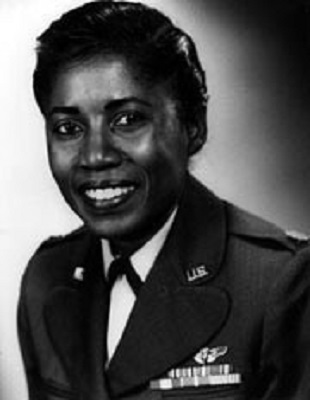
Nancy Leftenant-Colon


September 29 …
Nancy Leftenant-Colon stands as a pioneering figure in American healthcare and military history, remembered for breaking racial and gender barriers while reshaping the role of nurses in the United States Air Force and beyond.
Born on September 28, 1920 in Goose Creek, SC and raised in Harlem, NY, Leftenant-Colon nurtured a strong desire to serve in uniform during a time when opportunities for Black women in the armed forces were severely limited. Her commitment to combining professional nursing with patriotic service eventually established her as a transformative leader, leaving a legacy that intertwines healthcare, civil rights, and military integration.
After obtaining her nursing credentials, Leftenant-Colon encountered barriers in the U.S. Army Nurse Corps due to racial quotas. Undaunted, she took on civilian nursing roles and served in the Army Reserve before transitioning to the newly formed U.S. Air Force, when, in 1952, she became its flight nurse.
In 1961, she became the first Black nurse welcomed into the regular Air Force Nurse Corps, representing a historic milestone in military integration. Over a distinguished career spanning more than two decades, she advanced to the rank of lieutenant colonel, managing clinical operations, mentoring younger nurses, and advocating for excellence in military medicine. Her leadership played a pivotal role in modernizing care standards within military hospitals during a time of rapid transformation fueled by Cold War demands and emerging medical technologies.
After retiring from the military in 1965 with the rank of major, Leftenant-Colon continued to serve her country. From 1971 to 1984, she worked as a school nurse at the memorial high school in Amityville, NY, from which she had graduated in 1939. Then, she became the first woman national president of the Tuskegee Airmen Inc. in 1989.
Leftenant-Colon’s impact on American healthcare extended far beyond clinical practice. She actively promoted educational advancement for nurses, stressing the importance of specialization, leadership training, and policy involvement at a time when nursing sought greater professional recognition.
Her efforts paralleled those of contemporaries like Hazel Johnson-Brown, the first Black female general in the U.S. Army. Together, these pioneers broadened opportunities for minority women in military medicine, influencing recruitment, retention, and promotion policies.
Leftenant-Colon’s dedication to mentorship fostered a new generation of nurses who viewed military service as a pathway to leadership and innovation rather than a limitation.
In the larger context of American society and culture, Leftenant-Colon embodied the progress and challenges of the civil rights era. Growing up inspired by figures of disciplined service and excellence amidst discrimination, she found herself alongside barrier-breaking military leaders like Daniel James Jr.
Her career unfolded during a time when the armed forces mirrored and drove social change. By wearing her uniform with pride, she challenged stereotypes related to race and gender, helping to normalize the presence of Black women in command roles and professional domains that were previously inaccessible. Her public service and visible authority played a significant role in transforming cultural perceptions of leadership, healing, and national representation.
Throughout her life, Leftenant-Colon received numerous accolades honoring her military service and civic engagement, including commendations from the Air Force and recognition from nursing and community organizations. Yet, her most enduring legacy lies in the pathways she forged, demonstrating that excellence in healthcare and military leadership can mutually reinforce one another.
The story of Nancy Leftenant-Colon occupies a vital place in American history, exemplifying how personal determination, professional expertise, and patriotic dedication converge to reshape institutions and inspire lasting societal change.