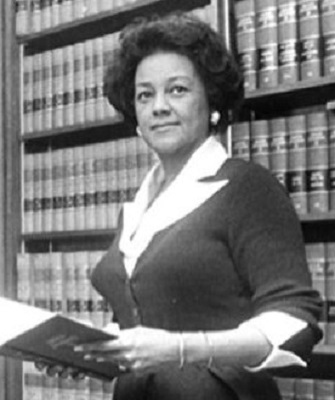
Jewel Lafontant



April 28 …
Jewel Lafontant was a trailblazing attorney and government official whose legal acumen and public service broke barriers for both women and African Americans in the United States.
Born on April 28, 1922 in Chicago, IL, Lafontant was raised in a family deeply committed to education and civil rights. Her father — C. Francis Stradford — was one of the founders of the National Bar Association. Inspired by his example, she pursued law during a time when few Black women were accepted in the profession.
Lafontant became the first Black woman to graduate from the University of Chicago Law School in 1946, setting the stage for a distinguished and historic career. Also that year, she married John W. Rogers Sr., a former member of the Tuskegee Airmen. Their son is investment executive John W. Rogers Jr.
Lafontant built a reputation as a skilled and fearless trial attorney, practicing both criminal and civil law. Her courtroom prowess and commitment to justice earned her widespread respect, and she quickly emerged as a leader in legal and civic organizations.
Throughout her career, she maintained a strong dedication to civil rights, women’s empowerment, and equal access to justice. Her rise in the legal field was marked by numerous firsts, including becoming the first female Deputy Solicitor General of the United States in 1973. In that role, she argued cases before the U.S. Supreme Court, helping to shape American legal doctrine at the highest level.
In addition to her legal work, Lafontant played a significant role in American government and diplomacy. Under President George H.W. Bush, she served as the U.S. Ambassador-at-Large and U.S. Coordinator for Refugee Affairs, where she oversaw humanitarian responses and international policy related to global refugee crises. Her work in this arena underscored her lifelong commitment to protecting human rights and expanding America’s role in global leadership. She also served on numerous presidential commissions and advisory boards under both Republican and Democratic administrations, always advocating for inclusive policy and equal representation.
Lafontant’s career intersected with several major historical moments, and she was frequently called upon to lend her voice to legal, political, and civic causes. She supported the advancement of Black professionals within federal institutions and legal education, and she mentored young lawyers and public servants who would go on to lead in their own right.
Lafontant’s advocacy extended beyond courtrooms and policy offices, as she spoke publicly about the challenges facing women and minorities in the legal profession and actively worked to dismantle institutional barriers. She received a Candace Award for Distinguished Service from the National Coalition of 100 Black Women in 1983.
Lafontant’s legacy is one of determination, excellence, and profound public service. She transformed what was possible for Black women in law and government, not through symbolic achievements alone, but through decades of meaningful leadership, action, and results.
The contributions of Jewel Lafontant laid the foundation for greater diversity within America’s legal system and inspired generations of women and people of color to pursue justice from within the system itself. As a pioneer whose impact was felt both nationally and internationally, she remains a vital figure in the story of American progress.