
October 9
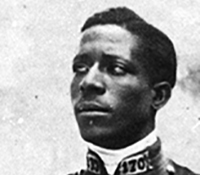
Eugene Jacques Bullard was one of the first African-American military aviators.
Bullard was born Eugene James Bullard on October 9, 1895 in Columbus, GA to William and Josephine Bullard, the seventh of 10 children. Growing up in the Jim Crow South, Bullard experienced racial discrimination early in life, which profoundly shaped his worldview.
Inspired by stories his father told of France’s more tolerant society, Bullard left home as a teenager and eventually made his way to Europe, determined to find a place where he could live with dignity and opportunity. His journey took him across the Atlantic, working on ships and performing as an entertainer, before settling in France just before World War I.
When war broke out in 1914, Bullard joined the French Foreign Legion and fought bravely in several key battles, including Verdun, where he was seriously wounded. After recovering, he transferred to the French Air Service and became the world’s first African American military pilot.
Flying with distinction in the Lafayette Flying Corps, Bullard completed more than 20 combat missions, earning several French military honors, including the Croix de Guerre. Despite his proven skill and bravery, Bullard was never allowed to fly for the U.S. military due to the racial segregation policies of the time.
After the war, Bullard remained in France, where he built a successful life as a nightclub owner and musician in Paris. His club became a popular gathering spot for artists, intellectuals, and entertainers of all backgrounds, including Josephine Baker and Louis Armstrong.
During World War II, Bullard again served France, this time as part of the resistance against Nazi occupation. He worked as a spy, using his nightclub as a hub to gather intelligence. Once again, he put his life at risk to fight for freedom, even as his adopted country was under siege.
After the fall of France, Bullard fled to the United States, where he hoped to find recognition for his service. Instead, he returned to a nation still entrenched in racial inequality. He worked menial jobs to support himself and lived in relative obscurity for decades.
Despite his distinguished record, he received little attention from the American public or government during his lifetime. It was not until the 1950s and 1960s that France began formally honoring Bullard for his heroism, and in 1959 he was made a chevalier (knight) of the Légion d’honneur, France’s highest order of merit.
Today, Bullard is remembered as a trailblazer and a symbol of courage and resilience. His contributions to aviation and his unwavering commitment to justice and equality have earned him a posthumous place in American history.

Eugene Jacques Bullard exhibit at the National Museum of the United States Air Force
In 1994, Eugene Jacques Bullard was commissioned as a second lieutenant in the U.S. Air Force — more than three decades after his death in 1961. His life serves as a powerful reminder of the many unsung heroes who challenged both enemy lines abroad and systemic injustice at home, leaving behind a legacy that continues to inspire generations.