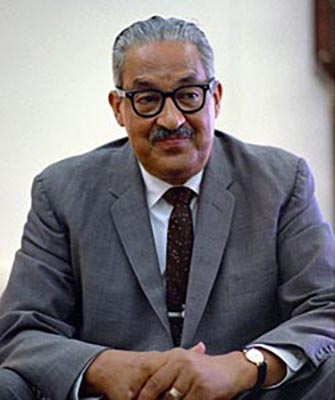
Thurgood Marshall

July 2
Thurgood Marshall, born on July 2, 1908, in Baltimore, MD, was a pioneering legal mind whose contributions fundamentally reshaped the American legal and civil rights landscape.
The great-grandson of enslaved Africans, Marshall was raised in a racially segregated society that denied Black Americans basic civil liberties. These early experiences with systemic injustice fueled his desire to fight inequality through the law, a path he would pursue with tireless conviction throughout his life. He graduated from Lincoln University and later Howard University School of Law, where he was mentored by Charles Hamilton Houston, another legal giant in the civil rights movement.
Marshall’s most enduring legacy began with his work for the NAACP Legal Defense and Educational Fund, where he served as chief counsel. In this role, he became the architect behind a series of legal challenges that targeted racial segregation in public education and public accommodations. His keen legal strategy was not merely confrontational but methodical, aimed at dismantling segregation law by law, court by court. His early victories in cases such as Smith v. Allwright (1944), which outlawed white primaries, and Sweatt v. Painter (1950), which challenged segregation in higher education, laid the foundation for a more ambitious target: ending segregation in public schools.
His most celebrated achievement came in 1954 with the landmark Supreme Court decision in Brown v. Board of Education of Topeka. Arguing before the Supreme Court, Marshall successfully persuaded the justices that segregation in public education violated the Equal Protection Clause of the Fourteenth Amendment. The Court’s unanimous decision declared that “separate but equal” had no place in American public schools, effectively overturning Plessy v. Ferguson (1896). This case became a cornerstone of the civil rights movement, offering legal and moral momentum for broader efforts toward racial equality.
Marshall’s work extended beyond the courtroom. He was a committed advocate for justice during the height of the civil rights movement, helping to coordinate legal strategies in support of civil disobedience, voting rights, and protections against racial violence. His legal victories gave activists a powerful set of precedents and tools to challenge discriminatory practices across the country. Unlike some contemporaries who worked outside the system, Marshall believed in transforming America from within its legal framework, and he succeeded in doing so.

Photograph of the U.S. Supreme Court in 1976. In the front row going from left to right: Byron R. White, William J. Brennan, Jr., Warren Burger (chief justice), Potter Stewart, and Thurgood Marshall. In the back row, going from left to right: William H. Rehnquist, Harry A. Blackmun, Lewis F. Powell Jr., and John Paul Stevens, III. (Color negative by Robert S. Oakes)
In 1961, President John F. Kennedy appointed Marshall to the U.S. Court of Appeals for the Second Circuit, marking the beginning of his judicial career. Six years later, President Lyndon B. Johnson nominated him to the Supreme Court, and in 1967, Marshall was confirmed as the first African American Justice in U.S. history. On the bench, he brought a profound sense of justice informed by a lifetime of battling racial oppression. His jurisprudence consistently reflected concern for the marginalized, emphasizing individual rights, due process, and equal protection under the law.
As a Supreme Court Justice, Marshall often found himself in the minority, especially as the Court shifted to a more conservative orientation in the 1970s and 1980s. Yet his dissents were powerful, eloquent reminders of the Constitution’s promise to protect the most vulnerable. He opposed the death penalty, advocated for affirmative action, and warned against a narrow interpretation of civil rights protections. Though not always prevailing in his opinions, Marshall’s legal philosophy influenced generations of lawyers and judges committed to civil liberties.
Marshall retired from the Supreme Court in 1991, ending a remarkable legal career that spanned nearly six decades. His departure marked the end of an era in which the legal system had been used as a potent weapon against racial and social injustice. While his voice was missed in the Court’s deliberations, his legacy endured — in the laws he helped change, the institutions he shaped, and the minds he inspired.
Thurgood Marshall passed away on January 24, 1993, but his impact remains indelible. As both an advocate and a jurist, he redefined what justice could look like in a pluralistic society. His life’s work not only helped dismantle institutional racism but also reaffirmed the capacity of the Constitution to serve all Americans, regardless of race.
In the annals of American history, Marshall stands not just as a legal titan but as a moral beacon, whose unwavering commitment to equality continues to light the path toward justice.