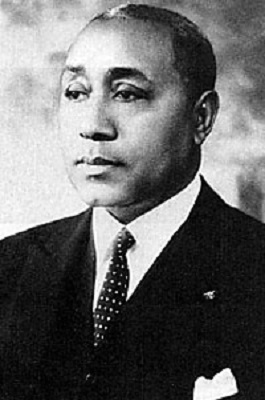
John Wesley Dobbs


March 26 …
John Wesley Dobbs was a visionary civic leader, orator, and advocate for African American political empowerment whose influence helped lay the groundwork for the Civil Rights Movement in Atlanta and the broader American South.
Often referred to as the “Mayor of Auburn Avenue,” Dobbs used his intellect, strategic thinking, and commitment to community organizing to challenge systemic racism and expand Black political participation at a time when voter suppression and segregation were deeply entrenched. His efforts reshaped Atlanta’s Black civic life and inspired a generation of activists and leaders.
Born March 26, 1882 in Marietta, GA, Dobbs moved to Atlanta at a young age and later graduated from Atlanta Baptist College (now Morehouse College). Though he worked as a railway mail clerk for most of his professional life, his passion lay in public service and civic activism. A brilliant orator with a commanding presence, Dobbs believed in the power of education, economic self-determination, and, most importantly, the ballot. He often said, “The key to the door of freedom is the vote,” a philosophy that guided his life’s work.
In the 1930s and 1940s, Dobbs led successful voter registration drives that dramatically increased the number of Black voters in Atlanta. As the founder and leader of the Atlanta Civic and Political League and later the Georgia Voters League, he worked tirelessly to educate and mobilize African Americans to register and participate in elections.
By 1946, largely because of Dobbs’s organizing, there were over 20,000 registered Black voters in Atlanta — a transformative shift that forced local politicians to recognize the power of the Black electorate and begin engaging with the community’s needs.
Dobbs also played a key role in pushing for desegregation and equal access to public services. He leveraged his political influence to advocate for the hiring of Atlanta’s first Black police officers in 1948, a major step toward racial integration in city government.
His advocacy often combined public pressure with back-channel diplomacy, building relationships with both white and Black leaders. He was known not only for demanding justice but also for modeling dignity, discipline, and civic responsibility within the Black community.
A committed member of Prince Hall Freemasonry, Dobbs rose to the position of Grand Master for the state of Georgia and used the Masonic organization as a vehicle for community improvement. Under his leadership, the Masons supported education, civic engagement, and economic development initiatives throughout Georgia. His dedication to collective uplift made him a respected elder statesman in Atlanta’s African American community, long before the formal civil rights era reached its peak.
Dobbs is deeply woven into the fabric of Atlanta’s political and cultural identity. He was a forerunner who laid the foundation for later leaders, including his grandson, Maynard Jackson, who would become the city’s first Black mayor. Auburn Avenue, once the heart of Black Atlanta, was renamed in part to honor Dobbs’s contributions.
The life of John Wesley Dobbs stands as a testament to the transformative power of grassroots leadership, civic engagement, and unwavering belief in the promise of democracy.