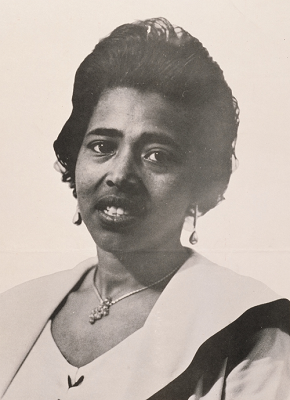
Victoria Gray Adams


November 5 …
Victoria Gray Adams was a civil rights organizer and political activist who played a key role in advancing voting rights in Mississippi. She was one of the founding members of the influential Mississippi Freedom Democratic Party.
Listen to her story:
Born Victoria Almeter Jackson in Hattiesburg, MS on November 5, 1926, Adams — the daughter of Mack and Annie Mae Ott Jackson — was raised in Palmer’s Crossing, a historically Black community near Hattiesburg. She attended DePriest Consolidated School and furthered her education at Jackson State College, Wilberforce University, and Tuskegee Institute.
Adams joined the Civil Rights Movement by campaigning for Black Mississippians’ voting rights. When SNCC organizers Curtis Hayes and Hollis Watkins came to Hattiesburg in 1962, she served as a vital link between the young organizers and the local Black community.
Adams motivated residents to register to vote and assisted with literacy and voter-education initiatives. This work demanded significant bravery, as discriminatory registration practices in the early 1960s had resulted in only a small portion of Hattiesburg’s Black population being registered to vote.
In 1964, Adams became a prominent statewide political figure when she challenged incumbent John C. Stennis for the U.S. Senate, making a notable run despite most African Americans in Mississippi remaining disfranchised. That same year, she joined Fannie Lou Hamer and Annie Devine as a leading member of the Mississippi Freedom Democratic Party (MFDP).
The MFDP contested the legitimacy of Mississippi’s all-white delegation to the Democratic National Convention in Atlantic City, arguing that a delegation created by a system systematically excluding Black citizens could not truly represent the state. Although the challenge did not displace the official delegation, it drew national attention to Mississippi’s discriminatory political system and contributed to reforms within the Democratic Party.
Adams remained dedicated to civil rights, political engagement, education, and Christian ministry throughout her lifetime. Historian Vicki Crawford has underscored the significance of Adams’s Christian faith in her conception of activism: political involvement and religious conviction were not isolated pursuits but interconnected expressions of service and justice. She subsequently served on the national board of the Southern Christian Leadership Conference and continued to speak and teach about the struggle for freedom.
Victoria Gray Adams died on August 12, 2006, leaving a legacy as one of the women who contributed to advancing Black Mississippians from systematic political exclusion to meaningful participation in American democracy.
Selected Sources:
- Annie Payton, “Victoria Gray Adams,” Mississippi Encyclopedia, Center for Study of Southern Culture, University of Mississippi, published April 14, 2018; updated September 10, 2025.
- Vicki Crawford, “Women in the Mississippi Freedom Democratic Party,” in Bettye Collier-Thomas and V.P. Franklin, eds., Sisters in the Struggle: African American Women in the Civil Rights-Black Power Movement (New York: New York University Press, 2001), 121–138; “Victoria Gray Adams,” *Mississippi Encyclopedia*.