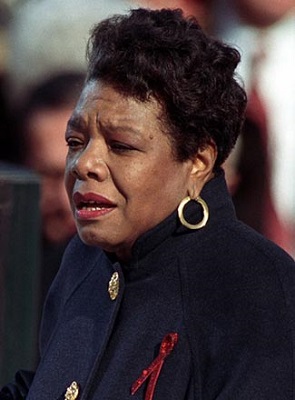
Maya Angelou


April 4 …
Maya Angelou was a towering literary figure, civil rights activist, and cultural icon whose life and work profoundly shaped American arts, identity, and consciousness.
Born Marguerite Annie Johnson on April 4, 1928, in St. Louis, MO, and raised in the segregated South, Angelou’s early life was marked by hardship, including poverty, racism, and trauma. Yet from those experiences, she forged a powerful voice — resilient, lyrical, and unflinchingly honest — that would echo through generations. Her early love of poetry and storytelling became the foundation for a career that broke boundaries and redefined the role of the artist in society.
Angelou rose to international prominence in 1969 with the publication of her memoir, I Know Why the Caged Bird Sings, a searing account of her childhood that explored themes of identity, abuse, and the transformative power of language. It was one of the first autobiographies by a Black woman to reach a wide audience and remains a seminal text in American literature. With its blend of poetic style and raw personal truth, the book challenged cultural taboos and opened new pathways for Black women writers. It marked the beginning of a seven-volume memoir series that traced her evolution from a silenced child to a woman of strength and vision.
Throughout her career, Angelou defied categorization. She was a poet, singer, dancer, filmmaker, essayist, and educator. Her poetry — including collections like And Still I Rise and Phenomenal Woman — celebrated Black beauty, feminine strength, and resilience in the face of oppression. Her words became affirmations for the marginalized and a source of inspiration for movements fighting for justice and equality. In performance, her commanding presence and rhythmic cadence made her poetry come alive, bridging literary artistry with oral tradition and cultural pride.
Angelou’s creative works spanned several genres. In music, she co-wrote the song “And So It Goes” for the 1988 album “Oasis” by Roberta Flack.
Maya Angelou was also deeply involved in the Civil Rights Movement, working with both Dr. Martin Luther King Jr. and Malcolm X. Her activism was not limited to the U.S. — she spent time in Ghana and other African nations, embracing pan-Africanism and expanding her global perspective. Her art and advocacy were intertwined; she used her voice not only to entertain but to educate, heal, and galvanize. In doing so, she became a symbol of Black dignity and a global ambassador for justice and compassion.
Later in life, Angelou continued to influence American culture through her public speaking, teaching, and contributions to film and television. She was awarded more than 50 honorary degrees and received numerous accolades, including the Presidential Medal of Freedom in 2011 from President Barack Obama. Her appearance at Bill Clinton’s 1993 inauguration, where she recited her poem “On the Pulse of Morning,” marked a historic moment of literary gravitas and cultural unity, affirming her status as a national treasure.
The legacy of Maya Angelou is one of empowerment, truth-telling, and artistic brilliance. Through her life’s work, she gave voice to the voiceless and showed that storytelling could be both deeply personal and politically transformative. Her words continue to resonate in classrooms, protest marches, and quiet moments of reflection, reminding the world that “we are more alike, my friends, than we are unalike.”
Maya Angelou’s enduring influence on American culture and history is a testament to the power of courage, creativity, and an unshakable belief in the human spirit.