Eddie Jefferson
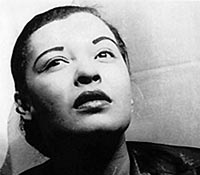
August 3 …
Eddie Jefferson was a jazz vocalist, lyricist, and former tap dancer whose imaginative approach to turning instrumental improvisations into songs helped establish vocalese as an important form of modern jazz expression and permanently changed the relationship between the jazz solo, the singer, and the lyric.
Listen to this story:
Born on August 3, 1918 in Pittsburgh, PA, Jefferson came of age during a period when jazz, vaudeville, tap dancing, blues, and popular entertainment were rapidly converging. He initially pursued tap dancing and later worked as a singer and lyricist, developing his musical identity during the rise of bebop in the 1940s. His education was principally experiential, acquired through performance, listening, writing, and immersion in the working jazz world.
Jefferson identified the extraordinary scat singer Leo Watson as a major influence, and his career was closely connected to several of the most important figures in jazz. James Moody became his most significant professional collaborator and mentor-like musical partner after the two met at Harlem’s Apollo Theatre in 1953. The arrival of Charlie Parker and the emergence of bebop also profoundly affected him, giving him a new musical vocabulary.
Jefferson’s greatest accomplishment was his pioneering role in vocalese, the practice of creating lyrics for existing instrumental solos and then performing those solos as vocal compositions, including Parker’s Mood, which represents an important early stage in that development. His best-known creation, Moody’s Mood for Love, supplied lyrics to Moody’s remarkable 1949 alto-saxophone improvisation of “I’m in the Mood for Love.”
Subsequent to 1952, Jefferson created memorable vocalese treatments of music associated with Charlie Parker, Lester Young, Miles Davis, Horace Silver, Coleman Hawkins, and others. His work demonstrated that an improvised jazz solo could possess enough melodic and emotional substance to support an entirely new verbal narrative.
Other contemporaries of Jefferson included Jon Hendricks, Annie Ross, Leon Thomas, and numerous instrumentalists whose work he transformed into vocalese. He also encountered Miles Davis and, according to accounts of their association, impressed Davis sufficiently during a 1958 performance at the Café Bohemia that Davis expressed interest in having him in his band. In the later 1970s, he formed an especially important partnership with the much younger alto saxophonist Richie Cole.
Among the other artists who admired or carried forward aspects of Jefferson’s legacy was another Pittsburgh native, George Benson. His influence also reached the broader vocal-jazz tradition represented by artists such as the Manhattan Transfer and later interpreters of vocalese.
Although Jefferson’s contribution was substantial, his career was marked by a striking contrast between artistic importance and formal recognition. He recorded for several record labels, but much of his work remained comparatively underappreciated during the 1950s and 1960s. His career experienced a significant revival in the 1970s due to a renewed public attention to vocalese.
Jefferson did not receive the kind of major Grammy, NEA Jazz Masters, or DownBeat Hall of Fame honors later bestowed on some of the musicians who carried vocalese forward. His most enduring accolades are instead artistic and historical. He is widely recognized as a pioneering figure in vocalese, and later musicians continued to record and perform his material.
Jefferson’s importance extends beyond the list of songs he wrote because his work changed how jazz history could be heard and narrated. By placing words inside the contours of celebrated improvisations, he turned solos by musicians such as James Moody, Charlie Parker, Lester Young, Coleman Hawkins, and Miles Davis into stories that could be sung, remembered, interpreted, and passed to audiences beyond the traditional instrumental-jazz world.
Jefferson’s combination of lyric writing, rhythmic phrasing, theatrical instincts, humor, and knowledge of jazz performance also reflected the interconnected traditions of Black American music and entertainment in the 20th century. That is at an intersection where jazz, blues, tap, comedy, storytelling, and stagecraft frequently informed one another.
Jefferson’s life ended tragically on May 9, 1979, when he was shot outside a Detroit club while his career was enjoying renewed momentum. His legacy survives in the continuing idea that an improvisation can become a song in its own right and that a singer can preserve, reinterpret, and extend the history contained inside an instrumental performance.
The influence of Eddie Jefferson on vocalese and vocal jazz represents one of the more distinctive contributions of a musician whose importance was recognized more fully by later generations than by the award institutions of his own era.