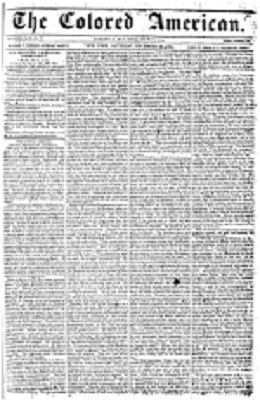
The Colored American (NY)


January 7 …
The Colored American (NY) was one of the most influential Black-owned newspapers of the antebellum United States, serving as a vital forum for African American thought, resistance, and cultural self-definition during a period of intense racial oppression.
Founded as “The Weekly Advocate” on January 7, 1837 in New York City, the newspaper — which underwent its name change on March 4 of the same year — emerged at a time when Black voices were often marginalized in mainstream publishing. Through its journalism, essays, and commentary, it boldly asserted that African Americans were vital participants in the nation’s intellectual, political, and moral discourse.
The newspaper’s most significant achievement was its establishment as a national platform advocating for equality and social justice. It reported on abolition, civil rights, education, and economic self-reliance, while courageously confronting slavery, segregation, and racist pseudoscience. It addressed a range of issues, from voting rights and discrimination in public transportation to international antislavery movements, linking local struggles to broader global reform efforts.
By consistently portraying African Americans as active agents in history, the newspaper fostered a politically engaged readership and championed the notion that equality is not merely a request but a legal and moral right.
As a publishing entity, the newspaper played a crucial role in solidifying the Black press as a vital and enduring component of American media culture. It offered a platform for essays, speeches, poetry, and editorials that celebrated Black intellectual achievement and cultural richness. Moreover, the paper functioned as a training ground for Black writers, editors, and organizers, reinforcing the belief that controlling print culture was essential to combating misrepresentation and silence. Its success proved that African American-owned publications could wield national influence despite navigating financial challenges and a hostile political landscape.
The newspaper was deeply influenced by abolitionist ideals, Black church leadership, and traditions of mutual aid and self-improvement. Notable figures associated with the paper included Charles Bennett Ray, a minister and editor whose leadership intertwined journalism with legal activism; Samuel Cornish, a trailblazing Black editor and abolitionist; and various contributors from the interconnected sphere of Black reform societies.
The paper coexisted with contemporaries like Freedom’s Journal and later The North Star, edited by Frederick Douglass, creating a broader ecosystem of Black newspapers that debated strategy while sharing a unified commitment to liberation. Its guiding principles included education, moral reform, civic engagement, and the belief that the written word has the power to dismantle injustice.
While the newspaper did not receive formal accolades during its operation, its historical significance has garnered lasting recognition. Scholars and cultural institutions now regard it as a cornerstone of American publishing and civil rights history, a publication that helped normalize the concepts of Black political authorship and intellectual authority. Its legacy persists in today’s Black press and the ongoing use of journalism as a catalyst for social change.
By affirming dignity, demanding equality, and shaping public discourse, The Colored American (NY) newspaper played a pivotal role in redefining both American media and democracy itself.