

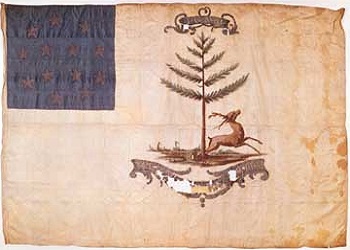
The Bucks of America were an African American militia unit that emerged in Massachusetts during the era of the American Revolutionary War, representing one of the earliest known organized Black military companies in the United States. Although precise records of their founding date are lost, the group is believed to have formed in or around Boston during the early years of the conflict, likely sometime after 1775 when the war began. Their historical significance lies not only in their service to the Patriot cause, but also in their symbolic role as evidence of African American participation in the struggle for independence.
Unlike many Continental Army units, the Bucks of America appear to have functioned primarily as a security and auxiliary force rather than a front-line combat unit. Historical accounts suggest that they were responsible for protecting property and maintaining order in Boston, particularly safeguarding merchant goods during wartime instability. Despite the lack of documented battlefield engagements, their role was essential in supporting the local wartime economy and ensuring civic stability.
Very few individual members of the Bucks of America are known by name. The most prominent figure associated with the group is George Middleton, who is believed to have served as the unit’s commander, often referred to as a colonel. Middleton was a significant figure in Boston’s Black community, later becoming a leader in civic and mutual aid organizations and an early advocate for Black rights. His involvement connects the Bucks of America to wider networks of African American activism, including associations such as Prince Hall Freemasonry.
Following the war, around 1789, the Bucks of America received formal recognition from Massachusetts Governor John Hancock, who presented the unit with a ceremonial flag honoring their service. This gesture symbolized public acknowledgment of their contributions, even as detailed records of their activities remained scarce.
The legacy of the Bucks of America lies in their representation of Black patriotism and civic duty during the nation’s founding. Though often overlooked in traditional narratives of the Revolutionary War, they stand as an important reminder that African Americans were active participants in shaping the early United States. Their story underscores both the contributions and the marginalization of Black soldiers, whose efforts helped secure American independence while they themselves continued to struggle for full citizenship and recognition.
About The Photo:
- The flag was probably made in Boston and was presented to a local militia company known as the Bucks of America sometime around the close of the American Revolution. Paint on silk with 13 stars in the dark area of the upper left, circa 1785-1786 (Massachusetts Historical Society Collection).
Selected Sources:
- Wikipedia contributors, “Bucks of America,” Wikipedia, The Free Encyclopedia.
- National Park Service, “African Americans in the Revolutionary War.”
- Fraunces Tavern Museum, “Bucks of America Flag.”