

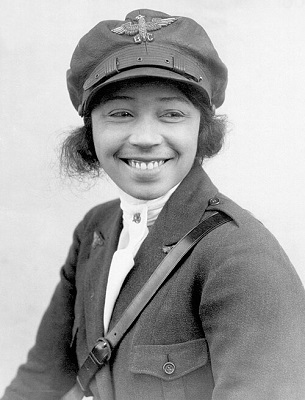
Bessie Coleman


January 26 …
Bessie Coleman broke barriers as the first Black woman and first Native American woman to earn an international pilot’s license and became an emblem of possibility for women and people of color in aviation and American life.
Born on January 26, 1892 into a large sharecropping family in Atlanta, TX, Coleman was raised in Waxahachie, and walked for miles to attend a segregated one-room school. At 18, she briefly attended Oklahoma Colored Agricultural and Normal University in Langston — now Langston University — before relocating to Chicago in 1915 to join her brothers who had migrated north.
In Chicago, Coleman worked as a manicurist and restaurant manager while saving for flight training. Denied admission to U.S. flight schools due to her race and gender, she studied French and took Berlitz classes. In 1920, she traveled to France to train at the Caudron Brothers’ school. She returned to the United States in 1922 as a licensed aviator.
Coleman’s most significant achievement was obtaining her Fédération Aéronautique Internationale pilot’s license on June 15, 1921. She then became a fearless barnstormer and stunt pilot, earning the nicknames “Queen Bess” and “Brave Bessie.”
Coleman amazed audiences with loops, figure eights, wing-walking displays, and parachute jumps at airshows across the country. Declining to perform at segregated venues, she used her fame to advocate for African American access to aviation and raised funds for a flight school for Black pilots.
Coleman’s ascent was supported by advocates within Chicago’s Black community. Robert S. Abbott and The Chicago Defender highlighted her pursuits and helped secure financial backing, particularly from banker Jesse Binga. Figures from the emerging Black aviation movement, including William J. Powell, who later founded the Bessie Coleman Aero Club in 1977 in her honor, worked to advance her ambitions.
Among her contemporaries were white women barnstormers and early male pilots, as well as later African American aviators like the Tuskegee Airmen, who regarded Coleman as a role model. Her example proved to be an inspiration for a number of pioneers in aviation, aeronautics, and astronautics — including John Robinson, Cornelius Coffey, Willa Brown, Janet Harmon Bragg, Robert H. Lawrence Jr., and Mae Jemison.
Tragically, the life and plans of Coleman were cut short when she died in a rehearsal crash in 1926. Ida B. Wells delivered a eulogy at her funeral, underscoring the high esteem she held in civil rights circles.
Coleman enjoyed widespread public recognition throughout her life and after her passing. She was celebrated in newspapers and public events, and beginning in 1931, annual memorial flyovers by Black pilots were held in her honor.
In 1995, Coleman was commemorated on a U.S. postage stamp and has since been recognized by museums, memorials, and the naming of streets and institutions. Her legacy continues to thrive, as seen in exhibitions and on a 2023 U.S. Mint coin in the American Women Quarters Program. Ongoing accolades in aviation and women’s history still honor her contributions.
The cultural impact of Bessie Coleman illustrates how race and gender barriers can be confronted directly, inspiring generations of Black and Native American pilots and contributing to broader movements for social justice, women’s rights, and expanded opportunities in American society.
