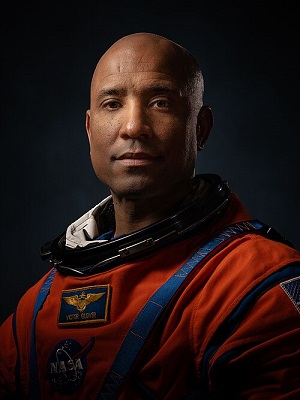
Victor Glover


April 30 …
Victor Glover is a U.S. Navy captain, test pilot, and NASA astronaut whose operational flights and public presence have advanced American aviation, human spaceflight, science outreach, and the cultural representation of Black astronauts.
Born on April 30, 1976 in Pomona, CA, Glover earned a Bachelor of Science in General Engineering from California Polytechnic State University in 1999. He later pursued graduate studies at the Naval Postgraduate School, Air Command and Staff College, and the U.S. Air Force Test Pilot School.
Glover’s blend of technical training, military education, test-pilot instruction, and extensive operational experience includes thousands of flight hours, carrier landings, and combat deployments. All those experiences equipped him for high-stakes flight test work and ultimately led to his selection for NASA’s astronaut class in 2013.
Glover’s notable achievements include serving as the pilot for SpaceX Crew-1, the inaugural operational Crew Dragon mission, and as flight engineer for Expeditions 64 and 65 aboard the International Space Station. During his mission, he spent approximately 168 days in space, completed four spacewalks, contributed to scientific research and technology demonstrations, and led outreach efforts from orbit.
Beginning on April 1, 2026 — with a planned flyby of the moon on April 6 — Glover piloted the Artemis II spacecraft during the first crewed lunar-flyby mission of the NASA Artemis program. By doing this, he made history as the first person of color to venture beyond low Earth orbit.
Glover’s career has garnered numerous military awards, including the Defense Superior Service Medal and Navy commendations. He also received NASA honors, like the Distinguished Service Medal and Space Exploration Medal, in addition to recognitions from Cal Poly and other institutions.
Glover credits his influences and mentors, including military and test-flight instructors from the U.S. Air Force Test Pilot School, along with senior naval aviators, for shaping his disciplined approach to risk management and systems-level thinking. At NASA, he has collaborated with peers such as Mike Hopkins, Christina Koch, Reid Wiseman, and Jeremy Hansen.
Glover has emerged as a prominent role model, formally mentoring students and early-career engineers through university programs and outreach initiatives. He also inspires underrepresented youth by referencing family role models, including the military service of his father and grandfather, as well as aviation pioneers.
Beyond his mission milestones, Glover has made a significant cultural and societal impact by enhancing public understanding of modern crewed spaceflight, showcasing the contributions of Black service members and scientists, and advocating for STEM education and community engagement. His outreach efforts, which encompass speaking to students, participating in public media and university events, and serving on advisory boards, further the mission to diversify aerospace careers.
Through a remarkable blend of operational accomplishments, public presence, and mentorship, Victor Glover has established himself as a vital figure in contemporary American aviation and space history.