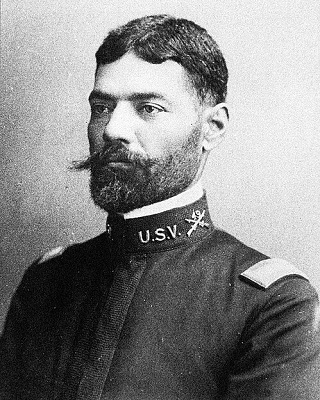
Edward Lee Baker Jr.
December 28 …
Edward Lee Baker Jr. was a U.S. Army officer whose bravery during the Spanish–American War and long service as a Buffalo Soldier helped shape both the legacy of Black military leadership and broader story of American expansion and reform at the turn of the 20th century.
Born on December 28, 1865 in what is now Laramie County, WY, Baker grew up in the post-Civil War frontier as the son of a Black American mother and a white French father. This exposed him early to the realities of racial hierarchy and the opportunities of the western frontier.
Baker developed practical skills like horsemanship and roping while nurturing an unusual intellectual curiosity, learning French from his father and later studying multiple languages, including Spanish and Russian. Joining the U.S. Army’s Ninth Cavalry at just 16 — one of the famed regiments of the Buffalo Soldiers — placed him within a rich tradition of African-American military service that originated during Reconstruction and westward expansion. This was where Black soldiers enforced federal policy while contending with discrimination in the ranks.
Baker’s military career was marked by steady advancement through merit in a time of limited opportunities for Black soldiers. Serving in both the Ninth Cavalry Regiment and 10th Cavalry Regiment, he rose from private to sergeant major, ultimately becoming the highest-ranking enlisted man in his regiment before being commissioned as an officer. This was an extraordinary accomplishment for an African American of his era.
Baker’s most notable action occurred on July 1, 1898 — during the Battle of San Juan Hill — when he bravely left cover to rescue a wounded comrade from drowning amidst heavy fire near Santiago, Cuba. This act of conspicuous gallantry earned him the Medal of Honor in 1902.
Baker’s service extended beyond Cuba into the Philippine-American War and the Philippine Scouts. This made him one of the highest-ranking Black officers in the Army by the time of his retirement.
Baker’s career intersected with that of other notable African-American officers and leaders, including fellow contemporaries like Charles Young, one of the first Black West Point graduates and a key figure in the professionalization of Black military leadership. His rise from the enlisted ranks to captain positioned him as an exemplar for future generations of Black servicemen, showing that discipline, education, and valor could challenge institutional barriers.
Baker’s multilingual skills and leadership roles suggest that he was influenced by the frontier’s spirit of self-reliance. He served as a model of cultivated professionalism within segregated units, embodying ideals that younger soldiers and future officers would aspire to.
Baker’s legacy endures beyond his lifetime through both military and cultural influence. His accolades — including the Medal of Honor, Indian Campaign Medal, Spanish Campaign Medal, and Philippine Campaign Medal — reflect a career that spanned significant phases of American imperial and frontier history.
As a Buffalo Soldier officer who rose to a leadership position in a segregated army, Baker played a crucial role in the gradual redefinition of African-American capability and citizenship in the United States. His story resonates culturally as well, as he was the maternal grandfather of jazz saxophonist Dexter Gordon, connecting his legacy to broader themes in American cultural history.
Remembered as both a soldier and a symbol, the life of Edward Lee Baker Jr. exemplifies how individual courage and perseverance helped reshape military institutions and challenge prevailing social boundaries during the late nineteenth and early twentieth centuries.