Christine Darden

September 10 …
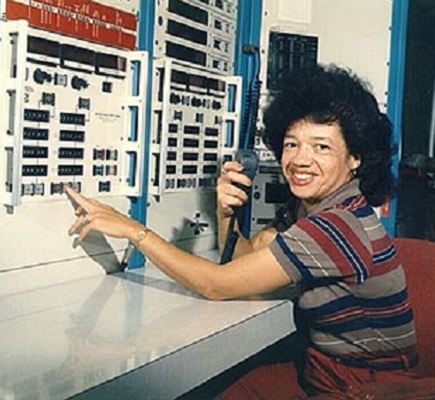
Christine Darden rose to prominence as one of the leading figures in American aeronautics, becoming a pioneer for both women and African Americans in science and engineering.
Listen to this story:
Born on September 10 1942 in Monroe, NC, from an early age, Darden displayed a keen interest in mathematics and problem-solving, passions that were nurtured by supportive teachers and a drive to pursue excellence despite the limitations imposed by segregation. Her early experiences growing up in the Jim Crow South shaped not only her ambitions, but also her determination to break through systemic barriers in education and the workforce.
After earning a bachelor’s degree in mathematics from Hampton Institute in 1962, Darden initially began her career as a math teacher, following the conventional path open to many educated Black women at the time. However, her ambitions extended beyond the classroom. She returned to academia to earn a master’s degree in applied mathematics from Virginia State College, setting the stage for her entry into the world of aeronautical research.
In 1967, Darden was hired by NASA’s Langley Research Center. There, she was initially placed in a pool of “human computers,” performing complex calculations for male engineers — a common practice before the widespread use of digital computers.
Darden soon questioned why women with the same qualifications as men were not given opportunities to work as engineers. Her inquiries led to a transfer into NASA’s engineering division, where she became one of the first African American women at the agency to be promoted to an actual engineering role.
Specializing in supersonic flight and sonic booms, Darden focused on minimizing the noise impact of aircraft breaking the sound barrier. Her research was critical in advancing the design of quieter supersonic aircraft, and she authored more than 50 technical publications in the field, influencing both military and commercial aerospace development.
Over the course of her four-decade career at NASA, Darden broke numerous glass ceilings. She became the first African American woman at Langley to be promoted into the Senior Executive Service, the highest level of federal civil service.
As a program manager and technical leader, Darden oversaw research that contributed to advancements in high-speed aerodynamics and computational fluid dynamics. Her work helped shift NASA’s focus toward more environmentally sustainable and noise-conscious designs in aviation, aligning technological progress with public and ecological concerns.
Darden’s journey was not only about scientific achievement, but also about challenging the gender and racial biases entrenched in American institutions. By advocating for herself and others, she opened doors that had long been closed to women and minorities in STEM fields.
Darden mentored countless young scientists, participated in outreach efforts, and used her platform to promote diversity in aerospace engineering. She understood that representation mattered, not only in inspiring future generations, but also in shaping the culture of scientific innovation to be more inclusive.
Darden’s life and work were brought to wider public attention through Margot Lee Shetterly’s “Hidden Figures,” which chronicled the contributions of Black women mathematicians at NASA. While the book and film focused more prominently on earlier figures like Katherine Johnson, Dorothy Vaughan, and Mary Jackson, Darden’s inclusion highlighted the enduring legacy of these pioneers and the ongoing impact of their breakthroughs. Her story helped broaden the understanding of how institutional change occurs over time through perseverance, inquiry, and quiet, but determined leadership.
Today, Darden is recognized as a trailblazer who changed the face of American science and technology. Her career not only advanced the frontier of aeronautical research, but also reshaped NASA’s internal culture, demonstrating the value of equity in scientific excellence.
Through her contributions to supersonic flight and her advocacy for inclusion, Christine Darden has earned a lasting place in American history. Her legacy is a powerful reminder that courage, intellect, and resolve can redefine what is possible — not just for an individual, but for an entire field.