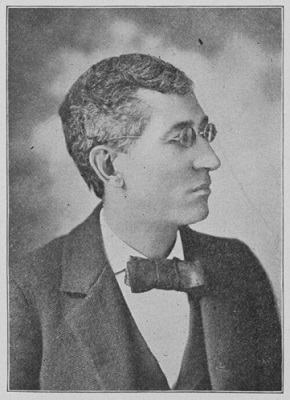
Timothy Thomas Fortune


October 3 …
Timothy Thomas Fortune was a pioneering journalist, editor, orator, and organizer whose militant advocacy and leadership in the black press helped shape the fight for civil rights, economic self-help, and political enfranchisement from Reconstruction through the early 20th century.
Born into slavery on October 3, 1856 in Marianna, FL, Fortune experienced an early introduction to politics and the world of printing, partly due to his father, Emanuel Fortune, who was involved in Reconstruction-era politics. He attended Stanton School in Jacksonville and spent a year in the preparatory department at Howard University (1876–77) before embarking on a largely self-directed educational journey as a printer, writer, and lecturer.
Fortune’s career as a newspaperman took him to Florida and New York, where he ultimately became the editor and co-owner of several influential Black newspapers, which merged to form The New York Age. He edited this publication from the late 1880s into the early 1900s, using it as a powerful platform to critique racism, lynching, and disenfranchisement.
Among his notable achievements, Fortune founded and led early national organizations advocating for African American civil rights, including the National Afro-American League — proposed in 1889 and organized in 1890 — and later took part in the Afro-American Council. He published significant works and hundreds of editorials, such as “The Negro in Politics” and “Black and White.”
Fortune edited the early writings of Booker T. Washington, and mentored emerging Black journalists and activists. Additionally, he was active in promoting Black business and industrial education, serving on executive committees for initiatives like the National Negro Business League.
Fortune’s newspaper campaigns resulted in legal challenges and victories, notably the case of Fortune v. Trainor, stemming from a 1890 hotel ejection. His editorial influence helped amplify national protests against racial violence and discrimination.
Fortune’s career was shaped by both close professional and at times tense relationships, particularly with Booker T. Washington, whom he advised and edited while collaborating on projects despite having differing strategies. He engaged intellectually with contemporaries such as Ida B. Wells, whose anti-lynching efforts he supported. He drew inspiration from the legacy of Frederick Douglass in Black journalism and later figures like Marcus Garvey, for whom he edited Negro World at one point.
Throughout his career, Fortune worked with and influenced a generation of Black writers and activists, supporting talents like Hubert Harrison and Zora Neale Hurston through his publication. He often referenced and found inspiration in earlier Black leaders and orators who championed activism through print and public speaking.
Although Fortune received widespread recognition during his lifetime as a leading African American journalist and activist, he did not accumulate formal national awards in the contemporary sense. His honors are evident in institutional remembrance, scholarly research, and the respect afforded to him by contemporaries and later historians regarding his leadership.
The legacy of Timothy Thomas Fortune continues in the histories of the Black press, organizations that succeeded the Afro-American League — such as the Niagara Movement and ultimately the NAACP — as well as in archival collections and historical markers that recognize his pivotal role in shaping African American public opinion and political activism.