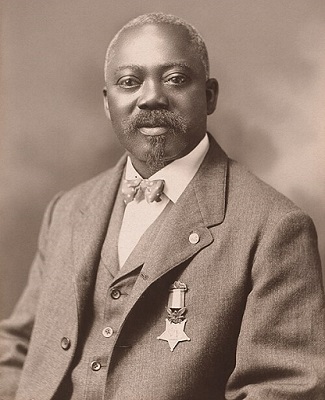
William Harvey Carney
February 29 …
William Harvey Carney was a courageous African American soldier whose heroic actions during the Civil War left a lasting impact on American military history and society.
Born into slavery in Norfolk, VA on February 29, 1840, Carney gained his freedom at a young age when his family escaped through the Underground Railroad to the North, ultimately settling in Massachusetts. His decision to enlist in the Union Army in March 1863 marked a pivotal moment in his life and in the larger fight for racial equality and recognition of African Americans in military service.
As one of the first African American soldiers in the Civil War, Carney contributed far beyond the battlefield, becoming a lasting symbol of bravery, resilience, and patriotism.
He joined the 54th Massachusetts Infantry Regiment, the first all-black regiment formed in the north state during the Civil War. Fueled by a strong sense of duty and the desire to aid in the emancipation of enslaved individuals, Carney was profoundly influenced by the leadership of Colonel Robert Gould Shaw, the regiment’s white commander, and the collective mission to showcase the valor and capabilities of African American soldiers.
Like many of his fellow troops, Carney was determined to prove his worth as a warrior and gain respect against the backdrop of the era’s racial prejudices His most significant act of bravery occurred during the assault on Fort Wagner in South Carolina on July 18, 1863. When the color bearer was shot, he courageously took up the American flag and refused to let it fall, enduring multiple wounds while keeping it aloft throughout the battle.
Carney’s extraordinary courage earned him the distinction of being the first African American to earn the Medal of Honor — awarded on May 23, 1900 for his valor during the assault, nearly 37 years after the events at Fort Wagner. His actions not only inspired his comrades, but also helped shift national perceptions of African Americans’ capabilities in combat. Although 20 African American men received the medal before him, Carney’s battle actions happened earlier than the others.
After the war, Carney returned to Massachusetts, where he lived out the rest of his life. His legacy remained vibrant. He emerged as an influential community figure, embodying the ideals of courage, integrity, and service.
Beyond his military achievements, Carney played a role in dismantling racial barriers in the armed forces, representing hope during the Reconstruction era and the ongoing struggles of African Americans in the post-war period. His Medal of Honor was a recognition of his bravery, but more importantly, his life itself became a testament to the potential of African Americans to overcome societal limitations.
Throughout his life, William Harvey Carney inspired both African Americans and the broader nation, demonstrating that heroism transcends race.