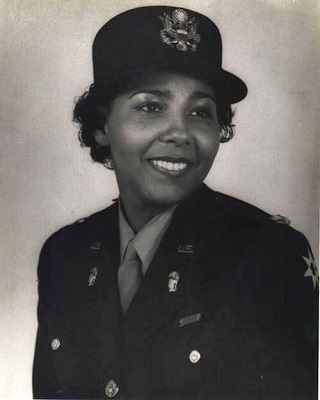
Charity Adams
December 5 …
Lt.Col. Charity Adams was a pioneering African American military officer whose leadership of the first Black women’s unit overseas during World War II helped transform the U.S. Army and broadened opportunities for women and people of color in American society.
Adams was born on December 5, 1918 near Columbia, SC to a family that held education and service in high regard. Her father, James Kerry Adams, a lawyer, served as an early influence, instilling values of civic engagement and personal excellence, while her mother, Lottie Guidrey Adams, nurtured her academic ambitions.
Adams graduated cum laude from Wilberforce University in Ohio in 1938, earning a degree in physical education and mathematics. While matriculating there, she was initiated into the Beta chapter of Delta Sigma Theta sorority. She subsequently obtained a master’s degree in guidance and counseling from Ohio State University in 1940. This strong academic foundation equipped her with the skills and confidence to excel in leadership roles, both in military and civilian spheres.
During World War II, with the creation of the Women’s Army Auxiliary Corps (which later became the Women’s Army Corps), Adams began her military service amidst a climate of segregation and discrimination.
In 1942, Adams was commissioned as a second lieutenant, making her one of the first African American women officers in the U.S. Army. Soon after, she was appointed commander of the 6888th Central Postal Directory Battalion, the first all-Black, all-female unit to serve overseas.
Under her leadership, the Six Triple Eight unit tackled a significant backlog of mail in England, France, and Belgium, ensuring that millions of letters and packages were delivered to American service members. She was part of a groundbreaking cohort — alongside fellow pioneers like Lt.Col. Jackie Parker — and together they worked to challenge the prevailing racial barriers in the military.
Adams’ leadership was influenced by both military experiences and the broader Civil Rights Movement. She looked up to trailblazing African American educators and civic leaders such as Mary McLeod Bethune, who advanced opportunities for Black women and girls.
Within the Army, Adams acted as a mentor to the women under her command, many of whom — including officers and noncommissioned officers like Lt. Ruth Reese — went on to achieve distinguished careers in education, public service, and the military, frequently crediting her example in shaping their own leadership paths. Though not all her protégés are widely recognized, the impact she had on a generation of women committed to service is profound.
After World War II, Adams continued to innovate in education and public administration. She earned a second master’s degree in public administration from the University of Minnesota in 1951 and dedicated her career to personnel management and community development, working with the U.S. Department of Labor and the Cleveland Public Library system.
For her remarkable leadership and service during wartime, Adams received the Legion of Merit, one of the highest military honors for meritorious conduct. In later years, veteran and civic organizations acknowledged her contributions to military integration, women’s advancement, and African American history, celebrating her as a role model for leaders across various sectors.
Adams’ legacy transcends her military achievements; she redefined service and leadership in a nation grappling with segregation and inequality. Through her courage, competence, and commitment to excellence, she ensured the 6888th Battalion achieved its mission and paved the way for the desegregation of the U.S. armed forces and the expanded roles of women in all military branches.
The life’s work of Charity Adams serves as a powerful testament to leadership grounded in integrity, resilience, and an unwavering belief in the potential of all who serve.