August 25 …
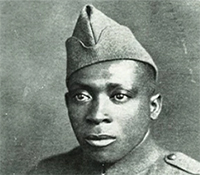
André Cailloux was a free Creole of color and Union Army captain whose leadership and death at the Siege of Port Hudson made him a powerful symbol of Black military service and sacrifice in the Civil War era.
Born into slavery on August 25, 1925 in Plaquemines Parish, LA and raised in New Orleans, Cailloux achieved freedom by the 1840s. He became literate in both English and French, trained as a cigar maker, and emerged as a property owner. He became a devoted family man, earning respect as a leader in New Orleans’s free Black community prior to the Civil War.
Cailloux’s vocational training and civic engagement established his authority among fellow Afro-Creoles and laborers, who would later serve under his command. Cailloux’s most significant achievement was organizing and leading a company within the 1st Regiment of the Louisiana Native Guard, which later became part of the Corps d’Afrique / USCT framework.
Commissioned as a captain in 1862, Cailloux led his men during the May 27, 1863 assault on Port Hudson, LA, where he was mortally wounded while encouraging his troops. His contemporaries included local Native Guard officers and Union commanders in the Department of the Gulf, such as Benjamin F. Butler and Nathaniel P. Banks — and fellow Black leaders and veterans like P.B.S. Pinchback, who honored his memory.
Cailloux’s impact transcended his battlefield heroics. His widely reported bravery and the large integrated funeral procession in New Orleans galvanized both Northern and Black support for the recruitment of African Americans. It bolstered claims for citizenship and equal treatment, and became a significant part of Black public memory during Reconstruction and subsequent civil rights movements.
Key stakeholders in his legacy included the free Black community of New Orleans, abolitionist organizations, Union military leaders evaluating Black enlistment, and Black veteran groups that invoked his example. Ultimately, the beneficiaries were African American enlistees and the broader moral and political arguments for Black service and rights.
In the wake of his death, Cailloux received numerous accolades, including public commendations in Union and abolitionist circles, an extraordinary funeral on July 29, 1863, in New Orleans with extensive civic participation and military honors. He later received commemorations from Black veteran groups and civic organizations.
Modern recognitions, such as the naming of cultural sites and tribute references celebrating his sacrifice, affirm the death and legacy of André Cailloux as an early and influential instance of Black officer leadership in American military history.