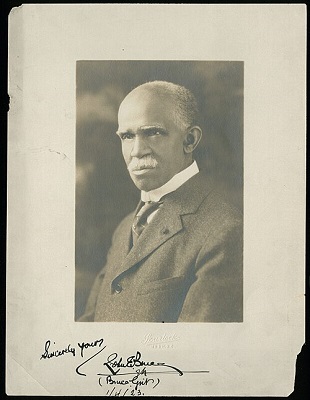
John Edward Bruce


February 22 …
John Edward Bruce was an influential African American journalist, historian, and activist whose writings, organizing, and editorial work advanced early civil rights efforts and the preservation of Black history in the late 19th and early 20th centuries.
Born on February 22, 1856 in Baltimore County, MD, Bruce — who also wrote under the pen name “Bruce Grit” — was primarily self-taught after leaving formal education at an early age. He apprenticed in printing and newspaper work, which laid the foundation for his enduring career in journalism and publishing.
Working as a printer and reporter in various cities, including Washington and Baltimore, he earned a reputation for sharp editorial commentary that intertwined civil rights advocacy with the documentation of African American achievements.
Among Bruce’s many accomplishments are the founding and editing of newspapers and periodicals dedicated to Black communities. He contributed pieces to The Colored American (DC) and served as editor for the Washington Globe newspaper. In the 1880s, Bruce founded The Pioneer newspaper — published as The Pioneer and Weekly — in Washington, DC.
Bruce’s writing of historical sketches and essays highlighted lesser-known African American figures and events and active participation in organizations that promoted racial uplift and the scholarly study of Black history. His journalism and historical writings sought to combat racist misrepresentations while providing resources for education and civic advancement.
Bruce played a pivotal role in organizing and leading historical and literary clubs, contributing to the emergence of early Black historical societies and archival initiatives. One such organization was the Negro Society for Historical Research, which he co-founded with Arturo Alfonso Schomburg, Alexander Crummell, and other African American intellectuals and historians.
Bruce was influenced by and interacted with prominent figures in Black intellectual and civil rights circles, such as Frederick Douglass, W.E.B. Du Bois, and Booker T. Washington. He adeptly navigated the complex debates surrounding strategy and leadership within the Black community.
While the documentation of Bruce’s mentors and collaborators is limited, his work closely aligned with leaders of the Black press and the organizers of literary and historical societies. He inspired younger Black journalists and historians, demonstrating a model of integrating reporting, editorializing, and historical preservation. His guidance significantly shaped local Black presses.
Bruce earned recognition within African American civic and literary circles for his editorial leadership and historical contributions. His legacy is evident in later institutional acknowledgments of early Black historians and the archival practices he helped establish.
The writings and organizational efforts of John Edward Bruce were instrumental in the cultural endeavor of documenting African American history and asserting claims to citizenship, dignity, and historical memory, which ultimately informed civil rights activism in the 20th century.