
August 4 …
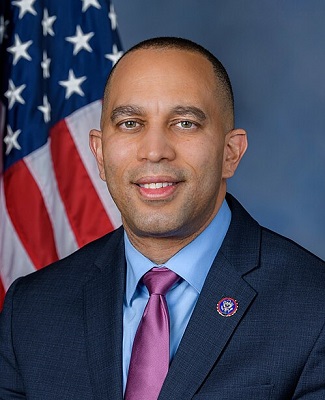
Hakeem Jeffries is an American lawyer and political leader whose rise in national politics has made him a prominent figure in the United States Congress and an influential voice in contemporary debates about law, governance, and democratic institutions.
Born on August 4, 1970 in Brooklyn, NY, Jeffries grew up in the Crown Heights neighborhood in a working-class family that emphasized the importance of education, civic duty, and community involvement. His parents, both social workers in New York City, instilled in him a deep understanding of public service and the challenges faced by urban communities.
Jeffries attended Binghamton University, where he studied political science and cultivated a passion for law and public policy. He later earned a master’s degree in public policy from Georgetown University and a law degree from New York University School of Law, focusing on constitutional law and civil rights—areas that would significantly impact his political aspirations.
Jeffries began his political journey in New York state politics, joining the New York State Assembly in 2007. During this time, he championed legislation addressing housing, criminal justice reform, and economic development in Brooklyn.
In 2012, he was elected to the United States House of Representatives, representing a congressional district in Brooklyn. He quickly gained a reputation for his legal acumen and his advocacy on issues like voting rights, criminal justice reform, and constitutional accountability.
Jeffries’s prominence within the Democratic Party grew, culminating in his election as House Democratic Leader in 2023. This made him the first Black lawmaker to lead a major party caucus in either chamber of Congress.
Throughout his career, Jeffries has worked alongside and been inspired by several prominent political figures. His contemporaries include leaders such as Nancy Pelosi, whom he succeeded as the Democratic leader in the House, as well as fellow Democrats like Jim Clyburn and Katherine Clark.
Jeffries often cites civil rights leaders such as Martin Luther King Jr. and political trailblazers like Shirley Chisholm as key influences, whose legacies have shaped his vision of public service and social justice. These inspirations have guided his focus on expanding democratic participation, safeguarding civil liberties, and reinforcing the government’s role in promoting equal opportunity.
Jeffries’s contributions to American politics have garnered recognition through various civic honors and affirmations from community organizations, legal associations, and advocacy groups that celebrate his work in civil rights, public policy, and Congressional leadership. While still actively engaged in his political career, he is widely regarded as a pivotal figure in shaping the legislative agenda and public messaging of House Democrats in the twenty-first century.
The leadership of Hakeem Jeffries signifies both a continuation of the civil rights struggles for political representation and a modern chapter in the evolving narrative of American democracy, reflecting broader shifts in the nation’s political culture and the increasing diversity within its governing institutions.