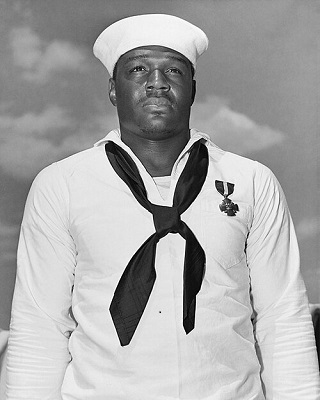
Dorie Miller
October 12 …
Dorie Miller was an American sailor and war hero whose courageous actions during World War II made him a symbol of bravery, challenged racial barriers in the U.S. military, and left a lasting impact on American society and culture.
Born on October 12, 1919 in Waco, TX, Miller grew up in a segregated society and worked on a family farm before enlisting in the United States Navy. With limited formal education, he joined the Navy in 1939 and was trained as a mess attendant, a role traditionally assigned to African American sailors due to the Navy’s segregationist policies. Despite these restrictions, Miller demonstrated remarkable skill, discipline, and determination, drawing inspiration from his family, his community, and the growing sense of duty among Black servicemen seeking to prove their capabilities in a discriminatory military environment.
Miller’s most renowned accomplishment came during the Japanese attack on Pearl Harbor on December 7, 1941. While serving aboard the USS West Virginia, he manned an anti-aircraft gun — despite having no formal training on the weapon — and successfully fired on attacking aircraft, helping protect his ship and fellow sailors.
His extraordinary heroism earned him widespread recognition and made him one of the first African American servicemen to receive national acclaim for combat valor. Miller was awarded the Navy Cross, the highest decoration given to Black sailors at the time, and he became a contemporary hero alongside other Pearl Harbor figures such as Dale Dye and fellow crew members of the USS West Virginia. His actions inspired both military peers and civilians, contributing to the eventual desegregation of the U.S. armed forces.
Beyond his military achievements, Miller became a cultural and symbolic figure in American society. His story was celebrated in newspapers, posters, and commemorative events, highlighting the courage and patriotism of African Americans during a period of systemic racial inequality.
While he did not mentor protégés in the conventional sense, his legacy influenced generations of Black servicemen and women, inspiring advocacy for equality in the armed forces and greater recognition of African Americans’ contributions to national defense.
Memorials, ships named in his honor, and posthumous awards continue to commemorate his bravery, securing Dorie Miller a place in U.S. military history and shaping the broader cultural understanding of heroism, courage, and civil rights.