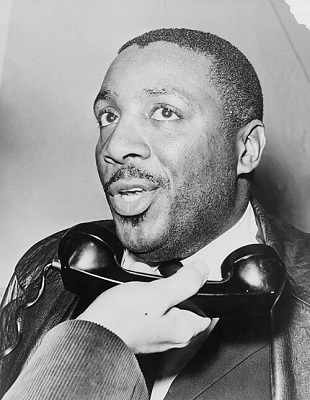
Dick Gregory


October 12 …
Dick Gregory was a groundbreaking comedian, writer, and civil rights activist whose fearless use of humor to challenge racism and injustice transformed American comedy and broadened the role entertainers could play in social change.
Born on October 12, 1932 in St. Louis, MO, he grew up in severe poverty within a segregated neighborhood, experiences that profoundly influenced the sharp social commentary in his performances. Gregory attended Southern Illinois University Carbondale on a track scholarship, showcasing his athletic talent until financial hardships forced him to leave school. His early encounters with adversity, discrimination, and working-class life provided him with a unique perspective that shaped his comedy, rooted not just in humor, but in critique, reflection, and activism.
Gregory achieved national fame in 1961 when he performed at the Chicago nightclub Hugh Hefner’s Playboy Club, stepping in for another act. That performance led to significant television appearances and played a key role in integrating the stand-up comedy scene for Black performers. Shortly after, he appeared on The Tonight Show Starring Jack Paar, becoming one of the first African American comedians invited to sit on the couch after his performance rather than leaving the stage immediately, marking a symbolic step towards greater visibility for Black entertainers.
Gregory’s routines blended sharp satire with commentary on segregation, politics, and daily life in America, influencing generations of comedians. He shared the stage with prominent figures such as Redd Foxx, Bill Cosby, Richard Pryor, and George Carlin, all of whom were instrumental in pushing the boundaries of stand-up comedy during the 1960s and 1970s.
In addition to his work in entertainment, Gregory became deeply engaged in the Civil Rights Movement, encouraged by leaders like Martin Luther King Jr. and Medgar Evers to leverage his national visibility in the fight for equality. He participated in demonstrations, voter-registration drives, and was arrested numerous times for civil disobedience.
Gregory also authored widely acclaimed books, including his autobiographical bestseller, Nigger: An Autobiography, which provided an unflinching examination of racism and poverty in America.
As his activism grew, Gregory became known for hunger strikes, health advocacy, and forthright commentary on various political issues, from war to economic inequality. He influenced a new generation of comedians and commentators, including Chris Rock and Dave Chappelle, who admired his ability to merge humor with social critique.
Throughout his distinguished career, Gregory received numerous accolades recognizing both his artistic impact and activism. He was honored with the NAACP Image Award and received lifetime achievement recognitions from cultural and civil rights organizations for his contributions to comedy and public discourse.
In 2017, the year of his passing, he was awarded the Mark Twain Prize for American Humor, acknowledging his transformative role in the history of stand-up comedy. Gregory’s legacy extends well beyond the stage; he redefined the role of a comedian, turning laughter into a tool for protest, education, and empowerment.
Through his performances, writings, and activism, Dick Gregory left an indelible mark on American culture, inspiring generations of artists to confront injustice with courage, intelligence, and humor.