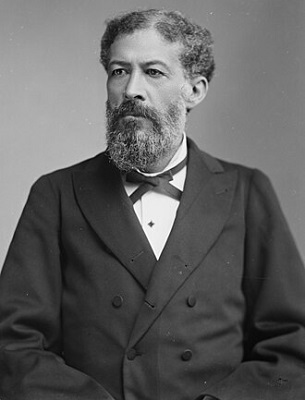
John Mercer Langston




December 14 …
John Mercer Langston was a pioneering abolitionist, attorney, educator, diplomat, and politician whose career helped redefine African American participation in public life during the 19th century.
As one of the pioneering Black Americans elected to public office in the United States and the first African American to represent Virginia in Congress, Langston’s life encapsulates the journey of Black activism from antebellum abolitionism through Reconstruction and beyond. His dedication to social justice, higher education, and federal governance positioned him as a key figure in the ongoing effort to align American democracy with its stated ideals.
Born free on December 14, 1829 in Louisa County, VA, Langston was the son of a formerly enslaved woman of African and Native American heritage and a white planter father who emancipated her prior to John’s birth. After losing his parents at a young age, Langston moved to Ohio, where he was nurtured in an environment that emphasized education and reform. He attended Oberlin College, where he earned both a bachelor’s and a master’s degree, becoming one of the first African Americans in the nation to attain such academic achievement.
Although he faced racial discrimination that barred him from law school, Langston diligently studied law on his own and gained admission to the Ohio bar in 1854. His intellectual growth was profoundly influenced by abolitionist principles and leaders such as Frederick Douglass, whose powerful speeches and activism inspired Langston’s own commitment to racial justice and civil rights.
Before the Civil War, Langston distinguished himself as a prominent advocate in the abolitionist movement, establishing antislavery societies and enlisting Black soldiers for the Union Army as conflict erupted. During Reconstruction, he held various public roles, including Inspector General of the Freedmen’s Bureau, where he championed the rights of formerly enslaved individuals seeking education, workplace protections, and political rights.
In 1870, Langston became the founding dean of the law department at Howard University, contributing to the establishment of one of the nation’s first Black law schools. Through this position, Langston mentored countless African American lawyers, intertwining legal advocacy with the broader quest for civil equality.
Langston’s political journey culminated in his election to the U.S. House of Representatives from Virginia’s Fourth District in 1888, marking him as the first African American congressman from the state. He served during a tumultuous period when the promises of Reconstruction were being undermined, yet he consistently advocated for voting rights and equal protection under the law.
Prior to this, Langston also served as the U.S. Minister to Haiti, representing American interests abroad and epitomizing the emerging, albeit contested, role of Black leadership in federal diplomacy. Among his contemporaries were figures like Blanche K. Bruce and Hiram Rhodes Revels, fellow African American officeholders who navigated the delicate political landscape of Reconstruction.
Although Langston did not receive contemporary-style accolades, his numerous appointments to significant positions and his election to Congress underscored his prominence. He later chronicled his life and values in an autobiography, enriching the narrative of African American literary and political culture.
Today, institutions such as the historically black college Langston University — and the town of Langston in Oklahoma — bear his name, honoring his lasting impact on higher education and civil rights.
Through his advocacy, scholarship, and public service, John Mercer Langston broadened the parameters of American citizenship and laid foundational intellectual and institutional groundwork for future equality movements, leaving a legacy intricately woven into the nation’s social and political history.