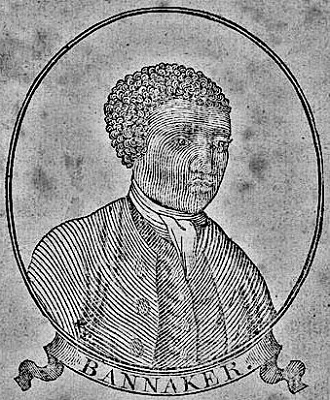
Benjamin Banneker


November 9 …
Benjamin Banneker was a self-taught mathematician, astronomer, surveyor, farmer, and author whose intellect and moral courage left a lasting imprint on American agriculture, science, publishing, and the early republic’s struggle with slavery and racial inequality.
In an era where opportunities for Black intellectual achievement were severely limited, Banneker emerged as a prominent figure through his dedication to study and practical innovation, earning recognition as one of the most formidable African American thinkers of the eighteenth century. His life symbolized the transition from colonial America to the new United States, showcasing how knowledge and determination could dismantle longstanding social barriers.
Born November 9, 1731 in Baltimore County, Province of Maryland, British America — near modern-day Baltimore — Banneker was the son of a free Black woman and a formerly enslaved African man. His maternal grandmother, Molly Walsh, an English immigrant, played a crucial role in securing the family’s land and stability, helping to establish the independent farm where Banneker would spend the majority of his life.
Although his formal education was brief — attending a local Quaker school for a time, where he benefited from a community that promoted literacy and relative racial tolerance — Banneker primarily educated himself, borrowing books and mastering mathematics and astronomy through diligent observation and calculation. His intellectual inspirations included renowned Enlightenment thinkers like Isaac Newton, whose scientific rigor greatly influenced Banneker’s own methodical exploration of the natural world.
Agriculture formed the backbone of Banneker’s livelihood and provided a platform for practical innovation. On his family’s tobacco farm, he applied mathematical precision to crop cycles and land management, illustrating how scientific reasoning could boost productivity. His early mechanical curiosity led him, in his 20s, to construct an impressive clock primarily made of wood, which was among the first of its kind built in America. This remarkable achievement, realized after studying a borrowed pocket watch, showcased both his mechanical ingenuity and his ability to translate theory into tangible craftsmanship.
While farming secured his economic stability, it was mathematics and astronomy that increasingly defined his intellectual persona. Banneker’s most renowned scientific contributions came through his astronomical calculations and almanacs. With encouragement and instruments from the Ellicott family — especially George Ellicott — he began making meticulous observations of celestial movements. His accurate predictions of solar and lunar eclipses earned him respect among his learned contemporaries.
Between 1792 and 1797, Banneker published a series of almanacs that interwove astronomical data, weather forecasts, and essays advocating for abolition and racial justice. These publications affirmed his place within the broader transatlantic culture of Enlightenment science and print, demonstrating that African Americans could meaningfully engage in intellectual discourse.
In 1791, Banneker was appointed to help survey the boundaries of the future Washington, DC, under the direction of Andrew Ellicott. His involvement in this foundational national project symbolized both his technical prowess and the delicate possibilities for Black advancement in the early republic.
That same year, he notably corresponded with Thomas Jefferson, enclosing a copy of his almanac and challenging Jefferson to reconcile the ideals of liberty with the harsh reality of slavery. Jefferson’s deliberate reply acknowledged Banneker’s capabilities, marking their exchange as a significant moment in the intellectual history of American abolitionism.
Banneker’s contemporaries included notable American figures such as Thomas Paine and Benjamin Franklin, whose writings and experiments helped shape the Enlightenment ethos in which he participated.
Although Banneker did not establish a formal school or mentor widely documented protégés, his published almanacs and the example he set inspired generations of Black intellectuals and activists, who cited him as evidence of African American intellectual equality. In this way, his legacy served as a form of mentorship across generations, encouraging future educators, scientists, and reformers.
While Banneker did not receive formal awards during his lifetime akin to modern scientific honors, his appointment to the federal surveying project and the widespread circulation of his almanacs represented meaningful recognition of his talents. Since his death in 1806, his name has been honored through schools, parks, and historical markers, celebrating him as a foundational figure in African American history and American science.
Through his achievements in agriculture, mathematics, astronomy, publishing, and moral philosophy, Benjamin Banneker significantly broadened the intellectual and civic horizons of the early United States, leaving a legacy that continues to influence American culture and historical memory.