

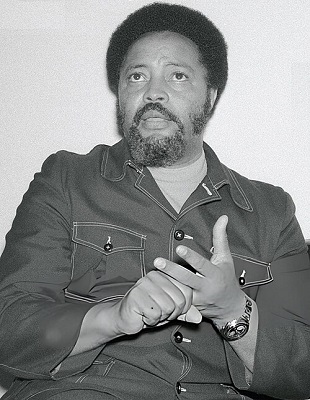
Hosea Williams


January 5 …
Hosea Williams was a dedicated civil rights activist and a prominent leader in the struggle for racial equality and social justice in America.
Known for his fierce commitment to nonviolent direct action and his work alongside Dr. Martin Luther King Jr., Williams played a pivotal role in the Civil Rights Movement, fighting for justice and equality for African Americans and marginalized communities across the United States. His lifelong dedication to activism left an enduring legacy in the fight for social change.
Born on January 5, 1926 in Attapulgus, GA, Williams grew up in the segregated South, witnessing the harsh realities of racial injustice firsthand. His military service during World War II broadened his worldview and reinforced his determination to advocate for civil rights upon returning home.
Williams pursued a degree in biology at the University of Minnesota, and his academic background shaped his practical approach to organizing and mobilizing individuals for social change. In the early 1950s, he became actively engaged in civil rights, joining the Southern Christian Leadership Conference (SCLC) and quickly emerging as one of its prominent leaders.
Williams was profoundly influenced by figures like Dr. Martin Luther King Jr., whose philosophy of nonviolent resistance became fundamental to his own activism. Serving as a trusted lieutenant to Dr. King, Williams played a key role in organizing major events, including the Selma to Montgomery marches, which were pivotal in securing voting rights for African Americans.
His focus on the practicalities of organizing included leading direct-action campaigns, managing protests, and tackling the logistical challenges of large-scale demonstrations. He also mentored younger activists and served as an inspiration to prominent leaders such as John Lewis and Andrew Young, who would go on to make significant contributions to American politics and civil rights.
As a champion for social change, Williams was instrumental in advancing legislative victories like the Civil Rights Act of 1964 and the Voting Rights Act of 1965. His relentless efforts often placed him in personal danger, facing arrests and violent confrontations with law enforcement. Yet, he remained steadfast in his commitment to nonviolence and social justice.
Collaborating with contemporaries such as Ralph Abernathy, Julian Bond, and Jesse Jackson, he contributed to dismantling segregation and promoting racial equality, collectively shaping the Civil Rights Movement into a national force for progress.
Williams’ activism garnered numerous accolades, earning recognition from various national and local organizations dedicated to social justice. He received numerous awards throughout his life, not only for his pivotal role in the Civil Rights Movement but also for his continued efforts to enhance the conditions of underserved communities. In the years following the movement, Williams continued to advocate for economic justice, poverty alleviation, and fair housing.
The contributions of Hosea Williams to American civil rights and social justice firmly establish him as one of the most courageous and effective leaders in the movement’s history.
