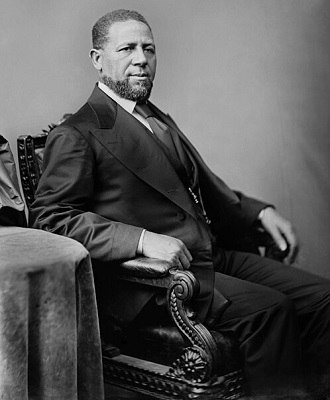
Hiram R. Revels


September 27 …
Hiram R. Revels was a minister, educator, and politician whose election to the United States Senate during Reconstruction marked a watershed moment in American history, symbolizing both the possibilities and fragility of Black political power in the post–Civil War era.
As the first African American to serve in the U.S. Senate — in fact, in either chamber of the U.S. Congress — Revels played a pivotal role in redefining citizenship, representation, and leadership during a tumultuous period in the nation’s history when the country was striving to rebuild and understand the true meaning of freedom.
Born free on September 27, 1827 in Fayetteville, NC, Revels hailed from a family that appreciated education and religious instruction, and he possessed a blend of African and European ancestry. He pursued theological and academic studies at Knox College and Oberlin College, institutions recognized for their abolitionist stances and progressive attitudes towards Black students.
Ordained as a minister in the African Methodist Episcopal Church and later affiliated with the Methodist Episcopal Church, Revels seamlessly merged his religious leadership with activism, preaching across the Midwest while advocating for abolition, temperance, and educational improvement. His faith and education significantly influenced his moderate political philosophy, which emphasized reconciliation, moral renewal, and civic engagement.
During the Civil War, Revels actively recruited African American soldiers for the Union Army and served as a chaplain, reinforcing his conviction in Black patriotism and equal citizenship. Following the war, he relocated to Natchez, Mississippi, where he ventured into politics amid the Reconstruction era.
In 1870, he was elected by the Mississippi legislature to the United States Senate, filling the seat previously held by Jefferson Davis. His swearing-in generated national attention and sparked intense debate as his opponents questioned the constitutionality of a Black man serving in the Senate. However, supporters ultimately won out, affirming the postwar amendments that expanded citizenship.
During his time in the Senate, Revels championed civil rights, advocated for equal access to education, and pushed for the fair reintegration of Southern states, often adopting a conciliatory tone to help stabilize the fragile political landscape. Revels was contemporaneous with other significant Black officeholders, including Blanche K. Bruce and various Reconstruction legislators who sought to enhance democratic participation in the South.
Although his Senate term was short-lived, he continued to influence public life through his work in education, becoming the first president of Alcorn Agricultural and Mechanical College (now Alcorn State University). There, he focused on industrial training, teacher preparation, and moral development, paralleling some aspects of the educational philosophy later championed by Booker T. Washington. By mentoring students and faculty, Revels fostered a generation of Black leaders who would continue the work of institution-building, even as Jim Crow laws increasingly restricted their efforts.
While he did not receive accolades typical of modern national awards, Revels was held in high regard during his lifetime for his integrity, eloquence, and dedication to public service. His groundbreaking Senate tenure secured his place in national history, while his leadership in education and ministry enriched community life.
The legacy of Hiram R. Revels embodies the ambitious goals of Reconstruction: the belief that formerly enslaved and free Black Americans could fully participate in governance, commerce, education, and civic life, significantly contributing to the nation’s democratic experiment despite significant opposition and setbacks.