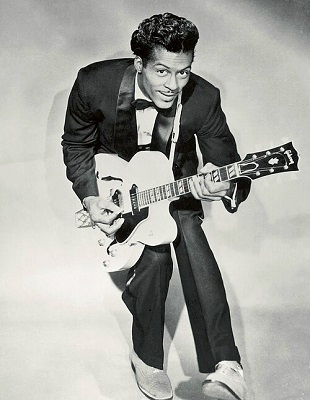
Chuck Berry
October 18 …
Chuck Berry was a pioneering guitarist, singer, and songwriter whose innovations helped define the sound and spirit of rock and roll, permanently altering the course of American music and popular culture.
Born Charles Edward Anderson Berry on October 18, 1926 in St. Louis, MO, Berry rose from a segregated America to become a pivotal figure in modern youth culture. With his electrifying guitar riffs, clever storytelling lyrics, and magnetic stage presence, he blended rhythm and blues with country influences, crafting a musical dialect that resonated with postwar teenagers and transformed the entertainment landscape.
Berry’s formative years merged traditional education with valuable life lessons. He attended Sumner High School in St. Louis, where his passion for music blossomed through church singing and school performances. Despite facing legal troubles that briefly derailed his journey, he emerged resolute in his quest for a music career.
Inspired by blues luminaries like Muddy Waters, Berry journeyed to Chicago, where Waters encouraged him to connect with Chess Records. Under the guidance of producer Leonard Chess, Berry launched his recording career, culminating in his breakthrough hit “Maybellene” in 1955, which introduced a bold new sound that combined blues structures with country-inflected guitar melodies and narratives revolving around cars, school, and young love.
Throughout the late 1950s and early 1960s, Berry unleashed a series of rock classics — including “Johnny B. Goode,” “Roll Over Beethoven,” and “Sweet Little Sixteen” — that became foundational texts of the genre. The signature guitar riff from “Johnny B. Goode” stands as one of the most recognizable melodies in popular music history, embodying the rebellious spirit of a generation.
His dynamic stage presence, highlighted by his iconic “duck walk,” captivated audiences and established a new standard for rock performances. With a storytelling style that vividly chronicled teenage life with humor and urgency, Berry distinguished himself from many of his contemporaries and broadened the thematic horizons of popular music.
Berry both inspired and competed with fellow pioneers such as Little Richard, Fats Domino, and Elvis Presley, each playing a crucial role in the rise of rock and roll. Simultaneously, his guitar style and songwriting significantly influenced later artists, including The Beatles and The Rolling Stones, who recorded his songs and revered him as a primary inspiration.
Keith Richards of The Rolling Stones famously considered Berry a foundational idol, and generations of rock guitarists drew from Berry’s melodic phrasing and theatricality. In this sense, Berry served as a bridge between African American rhythm and blues traditions and the ensuing global rock movement.
Despite navigating legal challenges and racial barriers that complicated his career, Berry’s cultural impact only intensified over the years. He was among the initial inductees into the Rock and Roll Hall of Fame in 1986, celebrated as a principal architect of the genre.
Berry also received a Grammy Lifetime Achievement Award and was honored by the Kennedy Center, solidifying his lasting influence on American arts and entertainment. His music, including “Johnny B. Goode,” was chosen for preservation in the Voyager Golden Record, a testament to Earth’s cultural milestones sent into space.
Chuck Berry’s legacy extends beyond his impressive catalog of hits. He was a cultural innovator who helped shape modern American identity. By focusing on youthful desires, mobility, and individuality in his songs, he captured the optimism and complexities of mid-29th-century America. His fusion of blues heritage with universal appeal challenged racial barriers in music and paved the way for countless artists.
Through his guitar, lyrics, and dynamic performances, Chuck Berry transformed American music into a global phenomenon and secured his place as one of the most influential figures in the history of popular culture.