

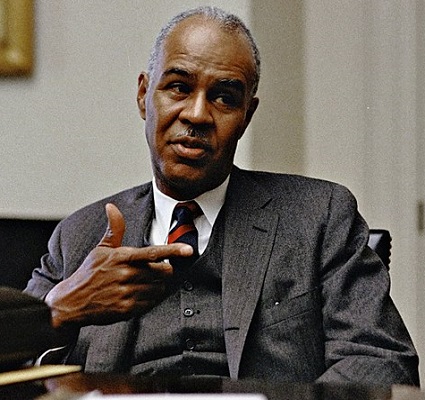
Roy Wilkins


August 30 …
Roy Wilkins was a steadfast architect of the modern Civil Rights Movement whose leadership, diplomacy, and moral clarity helped steer the struggle for racial equality through some of the most consequential decades in American history.
Born on August 30, 1901 in St. Louis, MO and raised in St. Paul, MN, Wilkins was profoundly influenced by a commitment to education, civic engagement, and the power of the press. He began his career as a journalist, which honed his understanding of public opinion and underscored the critical importance of strategic, measured advocacy in the fight against segregation and discrimination.
Wilkins gained national recognition through his involvement with the NAACP, joining the organization in the 1930s and ultimately serving as its executive secretary and later as executive director from 1955 to 1977. Under his guidance, the organization enhanced its legal and legislative efforts, playing a pivotal role in achieving landmark milestones such as the Civil Rights Act of 1964 and the Voting Rights Act of 1965.
Firmly believing in constitutional approaches — litigation, lobbying, and coalition-building — he regarded these methods as the most effective path towards equality. His steady leadership was crucial during tumultuous periods, including the struggles for school desegregation and the upheaval of urban riots.
Influenced by earlier civil rights leaders like W.E.B. Du Bois and Walter Francis White, Wilkins carried forward a legacy of intellectual rigor and institutional advocacy. He collaborated with contemporaries such as Martin Luther King Jr., A. Philip Randolph, and Whitney Young, sharing a commitment to the cause, albeit with differing styles.
Wilkins often prioritized cautious pragmatism over mass protest. Notably, he played a significant role as one of the principal organizers of the 1963 March on Washington, effectively bridging generational and ideological divides within the movement.
Wilkins’s contributions went beyond legislative achievements. He was also a compelling public speaker and commentator, leveraging television appearances and congressional testimony to present a compelling moral and constitutional case for civil rights. His leadership was recognized in 1967 when he received the Presidential Medal of Freedom, one of the nation’s highest civilian honors, celebrating his relentless efforts to advance justice through democratic means. Additionally, he was awarded numerous honorary degrees and civic accolades, reflecting the broad respect for his integrity and effectiveness.
His nephew was the American lawyer and civil rights leader Roger Wilkins, who served as Assistant Attorney General under President Lyndon B. Johnson from 1966 to 1969.
Roy Wilkins’s legacy rests on his unwavering commitment to equality under the law and his faith in the enduring promise of American democracy. In an era when calls for change ranged from nonviolent protest to militant resistance, he believed that persistent advocacy within constitutional frameworks could bring about societal transformation. His decades of service were instrumental in institutionalizing civil rights gains and securing protections that continue to shape American life today.
Through his principled leadership and steadfast dedication, Roy Wilkins left an indelible mark on the nation’s cultural and historical landscape.
