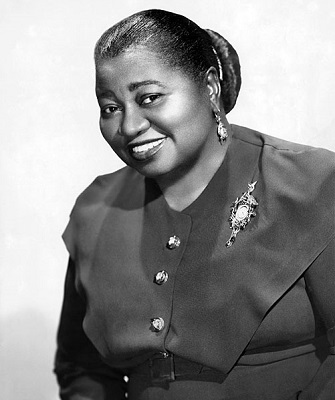
Hattie McDaniel

June 10 …
Hattie McDaniel was a pioneering American actress, singer, and entertainer whose remarkable talent and resilience helped break racial barriers in Hollywood and left an enduring mark on American film, culture, and history.
Born on June 10, 1893 (or 1895) in Wichita, KS to parents who had been enslaved, she was the youngest of 13 children. Growing up immersed in musical and theatrical performance with her family’s minstrel troupe, she honed talents that would later define a remarkable career in entertainment. Rising from humble origins on the vaudeville and radio circuits to international acclaim, McDaniel’s journey showcased both her extraordinary artistry and the racial challenges of her time.
Early in her career, McDaniel performed in traveling minstrel shows and became one of the first Black women to be featured on American radio, displaying her skill as a singer, songwriter, and comedian. Before establishing herself in Hollywood, she toured with various ensembles and made a name for herself in nightclubs, drawing increasing attention to her talent.
Upon arriving in Los Angeles, she began landing small film roles in the early 1930s, and by 1934, she garnered acclaim in notable films like Judge Priest and The Little Colonel, where her vibrant performances earned her recognition alongside leading stars such as Shirley Temple and Lionel Barrymore. Despite the limited opportunities available to Black performers during that time, McDaniel infused depth and warmth into every character she portrayed.
Her most celebrated achievement came with her role as Mammy in Gone with the Wind (1939), a performance that won her the Academy Award for Best Supporting Actress in 1940. That made her the first African American to be nominated for and win an Oscar — a milestone that echoed throughout the entertainment industry.
This groundbreaking success not only paved the way for McDaniel, but also symbolized progress for Black artists in Hollywood, even as segregation and discrimination persisted. At the award ceremony, she was required to sit at a segregated table due to the venue’s racist policies.
Throughout the 1940s, McDaniel continued to thrive in film and radio, becoming the first African American actress to star in her own weekly radio program with The Beulah Show in 1947. The show would later transition to television, enhancing her visibility and influence.
McDaniel also organized entertainment for Black troops during World War II as chairwoman of the Negro Division of the Hollywood Victory Committee, delivering performances to segregated soldiers and bolstering morale.
McDaniel’s contemporaries included legendary figures like Clark Gable and Vivien Leigh, with whom she shared the screen, as well as allies such as Bette Davis, who supported her during wartime tours.
Civil rights advocates criticized her for the stereotypical roles she often played. However, McDaniel remained convinced that her success opened doors for Black performers and challenged public perceptions.
In addition to her Oscar, she was honored posthumously with two stars on the Hollywood Walk of Fame — one for her contributions to radio and another for film. She was inducted into the Black Filmmakers Hall of Fame.
The legacy of Hattie McDaniel as a pioneering figure in American entertainment continues to inspire generations of artists who follow in her footsteps.