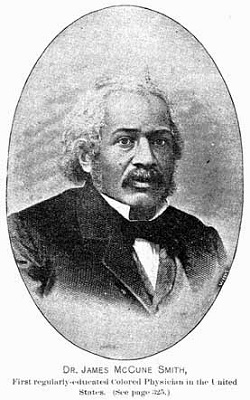
James McCune Smith



April 18 …
James McCune Smith was a groundbreaking physician, scholar, and social reformer whose life exemplified the integration of scientific achievement with advocacy for racial equality, making him one of the most remarkable African American figures of the 19th century.
Born on April 18, 1813 in New York City to parents who had escaped slavery, Smith overcame the systemic barriers of his time to become the first African American in the United States to earn a medical degree, achieving this distinction in 1837 at the University of Glasgow in Scotland, as American universities then barred Black students from enrollment.
Smith made extensive and innovative contributions to medicine. He practiced as a physician in New York City, running his own clinic and serving as the attending physician for the New York African Society for Mutual Relief, an essential community health organization. He published medical research, engaged in public health discussions, and advocated for sanitary reforms that enhanced the lives of New Yorkers.
Beyond his clinical practice, Smith was a trailblazer in merging rigorous science with social responsibility, using his expertise to combat racist pseudoscience and empirically demonstrate that African Americans were intellectually and physically equal to whites — a courageous stance amid a climate thick with prejudice and discrimination.
His education and mentors in both the United States and Europe deeply influenced Smith. At the African Free School in New York, dedicated teachers instilled in him intellectual rigor and civic responsibility. In Glasgow, he learned from prominent medical instructors and absorbed the ideals of reason, empiricism, and equality from the European Enlightenment. These experiences shaped his dual role as both a healer and a public intellectual
In 1855, Smith co-founded the Legal Rights Association, a pioneering civil rights organization. He also collaborated with contemporaries such as Frederick Douglass, William Still, and David Ruggles on antislavery efforts and civil rights initiatives, while also maintaining correspondence with European scientists and reformers, bridging transatlantic networks of thought and advocacy.
In addition to his medical career, Smith was a prolific writer and lecturer, contributing to newspapers, journals, and speeches on both scientific and social issues. He challenged the pseudo-scientific underpinnings of racism in widely-read articles, arguing that prejudice, rather than biology, was the root of inequality. His writings reached audiences beyond the African American community, shaping both scholarly debate and public opinion.
Smith epitomized the engaged intellectual, harmonizing professional expertise with moral and civic commitment, and using knowledge as a weapon against injustice.
Although formal accolades for African Americans were scarce during his lifetime, Smith’s legacy has garnered him posthumous recognition as a trailblazer in medicine, public health, and civil rights. He is celebrated as the first African American to hold a medical degree in the United States, as a champion of science against racism, and as a figure whose life intertwined health, education, and social reform.
James McCune Smith demonstrated that intellectual excellence and moral courage could coexist, leaving an indelible mark on American medicine, culture, and the ongoing pursuit of equality.