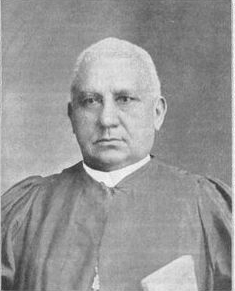


February 1 …
Henry McNeal Turner was a pioneering African American bishop, politician, and advocate whose life and work left a profound mark on American religion, politics, and history.
Born on February 1, 1834 in Newberry, SC to free Black parents, Turner defied the limitations of his time by teaching himself to read and eventually entering the ministry of the African Methodist Episcopal (AME) Church. His deep spiritual conviction and rhetorical skill quickly elevated him to prominence within the denomination, where he championed the cause of Black autonomy and religious empowerment. Turner believed that the church was not only a spiritual refuge but also a critical institution for the advancement and liberation of African Americans.
During the Civil War, Turner was appointed by President Abraham Lincoln as the first African American chaplain in the United States Colored Troops, marking a significant moment in both military and religious history. His service further solidified his belief in the moral and political necessity of Black leadership in all spheres of American life. After the war, he became a key figure in Reconstruction politics in Georgia, where he was elected to the state legislature in 1868. However, despite his election, he and other Black legislators were expelled by their white counterparts, an act that Turner condemned as a blatant affront to justice and democracy.
Undeterred by these setbacks, Turner used his oratory and writing to challenge systemic racism and advocate for civil rights. He was among the earliest public figures to argue that African Americans should consider emigration to Africa, not as an escape, but as a form of empowerment and reclamation of dignity. His support for the back-to-Africa movement made him a controversial figure, yet it reflected his unyielding belief that Black people deserved not only equality but also sovereignty. He famously declared that “God is a Negro,” a radical theological assertion meant to affirm Black divinity and counter white supremacist religious ideology.
Turner’s leadership within the AME Church grew over the years, culminating in his elevation to bishop in 1880. As a bishop, he expanded the church’s reach both nationally and internationally, especially in West Africa, where he helped establish AME congregations. His vision of a global Black Christian identity laid the groundwork for later Pan-Africanist and liberation theology movements. He encouraged African Americans to see themselves as part of a larger diasporic struggle for freedom and self-determination, and he viewed the church as the central institution through which this vision could be realized.
Turner’s life was one of bold intellect, prophetic vision, and relentless advocacy. He challenged the moral failures of both church and state, demanding that America live up to its democratic ideals while also carving out new possibilities for Black life beyond its borders.
Through his work as a preacher, politician, and thinker, Henry McNeal Turner helped define the contours of African American political theology and laid a foundation for future civil rights movements. His legacy endures as a testament to faith in action and the power of visionary leadership in the face of enduring injustice.