
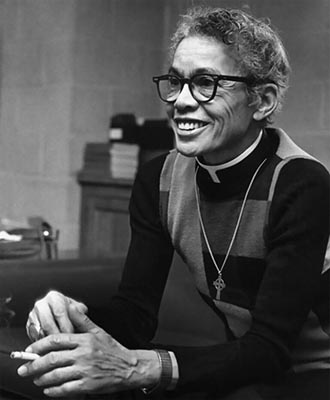
Pauli Murray


November 20
Pauli Murray was an American lawyer, social activist, legal scholar and theorist, author and lastly an Episcopal priest. A staunch advocate for the rights of women and people of color, Murray fought tirelessly for civil rights directly on the ground but also intellectually, articulating the intellectual foundations of the two great social justice movements of the twentieth century, the civil rights movement and the fight for gender equality.
Born Anna Pauline Murray on November 20, 1910 in Baltimore, MD, Murray was essentially orphaned and then raised by her maternal aunt in Durham, NC. At age 16, she moved to New York City to attend Hunter College and graduated with a Bachelor of Arts degree in English in 1933.
In 1940, Murray and a friend sat in the whites-only section of a Virginia bus. Both were arrested for violating state segregation laws. This incident and her subsequent involvement with the socialist Workers’ Defense League, encouraged her to pursue a career as a civil rights lawyer. She enrolled in Howard University’s law school, the only woman in her class. Murray thrived at Howard.
In 1944 Murray wrote a paper proposing a challenge to the “separate” part of the Plessy vs. Ferguson (1896) Supreme Court decision as a violation of the 13th and 14th Amendments. This very argument eventually formed the basis for the 1954 Brown vs. Board of Education case. Perhaps not coincidentally the professor for whom Murray wrote the paper served on the team which argued the inherent inequality of segregated education.
Murray graduated first in the class of 1944 and pursued but was denied a post-graduate position at Harvard University because of her gender. Murray instead earned a master’s degree in law from the University of California, Berkeley, and in 1965 became the first African American to receive a Doctor of Juridical Science degree from Yale Law School.
As a lawyer, Murray argued for civil rights and women’s rights. NAACP Chief Counsel Thurgood Marshall considered Murray’s 1950 book States’ Laws on Race and Color, the bible of the civil rights movement. President John F. Kennedy appointed Murray to the 1961–1963 Presidential Commission on the Status of Women; and in 1966 Murray helped organize the National Organization for Women (NOW), working with Ruth Bader Ginsburg to coauthor the ACLU brief in the landmark 1971 Supreme Court case Reed v. Reed. This case acknowledged and articulated the “failure of the courts to recognize sex discrimination” for what it is, its features and prevalence.
In 1973, Murray turned from academia toward ministry activities in the Episcopal Church, becoming in 1977 the first African-American woman ordained an Episcopal priest. In addition to her legal and advocacy work, Murray published two well-reviewed autobiographies and a volume of poetry. Initially published in 1970, the poetry collection, “Dark Testament,” was reissued in 2018.
Pauli Murray died of cancer in Pittsburgh on July 1, 1985, but Murray’s legacy lives on. The Episcopal Church sainted Murray in 2012, Yale University named a residential college after Murray, and Murray’s childhood home in Durham was designated a National Historic Landmark.
Anna Pauline “Pauli” Murray will be remembered as one of the most important social justice advocates of the 20th century.
Footnotes:
- Wikipedia “Pauli Murray.” Accessed May 8, 2025.
- Rothberg, Emma. “Pauli Murray.” National Women’s History Museum, 2021. Accessed May 8, 2025.