
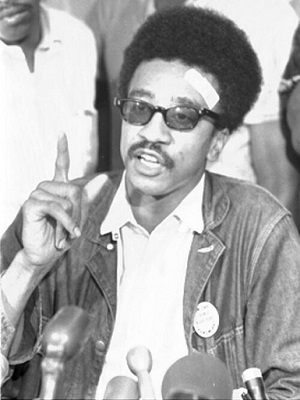
H. Rap Brown


October 4 …
H. Rap Brown, born Hubert Gerold Brown on October 4, 1943, in Baton Rouge, LA, emerged as a powerful voice in the Black Power movement of the 1960s.
Known for his fiery rhetoric and uncompromising stance against racial injustice, Brown became a prominent figure in the fight for civil rights and Black liberation. His early activism began during his college years at Southern University, but his influence grew significantly when he joined the Student Nonviolent Coordinating Committee (SNCC). By 1967, he had risen to national prominence as SNCC’s chairman, succeeding Stokely Carmichael.
As chairman of SNCC, Brown embraced and advanced the idea of Black Power, moving the organization further from its nonviolent roots and toward a more radical critique of American racism and capitalism. He became known for his passionate speeches that called out systemic oppression and urged Black Americans to assert their rights through self-defense and self-determination. His declaration that “violence is as American as cherry pie” became one of his most quoted lines, symbolizing his belief that the violence inflicted on Black communities was ingrained in the fabric of the nation.
Brown’s activism led to frequent clashes with law enforcement and government agencies. In 1967, after delivering a speech in Cambridge, MD, a confrontation broke out that resulted in gunfire and arson, and Brown was wounded during the incident. This event heightened government scrutiny, and he was soon listed as a wanted fugitive. Like many other Black activists of the time, Brown was targeted by the FBI’s COINTELPRO program, which sought to disrupt and discredit Black radical organizations and their leaders.
In the early 1970s, Brown converted to Islam while in prison and changed his name to Jamil Abdullah Al-Amin. After his release, he stepped away from national politics and became a respected Islamic leader in Atlanta, GA, focusing on spiritual guidance and community development. Despite his departure from the spotlight, his past remained under close watch. In 2000, he was arrested and later convicted for the murder of a sheriff’s deputy, a case that many of his supporters believe was deeply flawed and politically motivated.
Brown’s legacy is complex and layered. He remains a symbol of uncompromising resistance to racial injustice, a man who spoke truth to power during one of the most turbulent times in American history. While his later years were overshadowed by legal battles, his early contributions to the civil rights and Black Power movements left an undeniable mark.
Through his activism, leadership, and writings — including his autobiography Die Nigger Die!, published in 1969 — H. Rap Brown challenged America to confront the deep roots of its racial inequality and inspired a generation to fight for liberation and justice.