
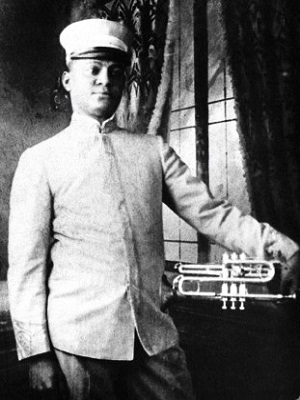
Freddie Keppard

February 27 …
Freddie Keppard was a pioneering figure in early jazz whose powerful playing and leadership helped bring New Orleans music to wider audiences in the early 20th century.
Keppard was born on February 27, 1890 in New Orleans to a working-class Creole family deeply immersed in the city’s vibrant musical heritage. Like many early jazz musicians, he learned music informally, drawing inspiration from brass bands, street parades, and local gatherings rather than through formal education.
Mastering the cornet, Keppard honed his unique style by performing in local ensembles during his youth. He earned a reputation for his bold tone and innovative improvisations, which positioned him as a key figure in the evolution of jazz.
Keppard led Freddie Keppard and His Jazz Cardinals and the influential Original Creole Orchestra, one of the first New Orleans ensembles to tour beyond the region. The Creole Orchestra’s tours throughout the Midwest and Canada in the 1910s were instrumental in spreading New Orleans jazz and introducing it to audiences in cities like Chicago and San Francisco.
The group delayed recording, partly due to Keppard’s reluctance to make phonograph records. Their performances were highly respected and helped establish the early jazz performance style and group interaction.
Keppard was influenced by the brass band and ragtime traditions of New Orleans, and in turn, he inspired a generation of jazz musicians. His contemporaries included iconic figures like King Oliver and Buddy Bolden, the latter often recognized as a pivotal influence on the development of jazz.
Many young brass players who experienced Keppard’s touring bands derived elements of their technique and stage presence from him. His commanding approach significantly impacted how future cornet and trumpet players viewed their instruments, especially leading up to the emergence of Louis Armstrong. Keppard’s peers also comprised other touring jazz ensembles and pioneering musicians bringing New Orleans music into new cultural realms.
Formal awards and accolades for jazz musicians were scarce during Keppard’s time, yet his legacy has been honored by later generations of historians, musicians, and jazz institutions that acknowledge his vital role in the early jazz movement. Recordings from the 1920s featuring his New Orleans bands have since been reissued and celebrated as historical milestones of early jazz artistry.
Keppard’s contribution to American music extends beyond his performances. He played a crucial role in introducing New Orleans jazz into the wider landscape of American entertainment and culture, during a period when this genre was just beginning to gain recognition as a significant artistic expression.
Keppard’s life and work embody the vibrancy and creativity of early jazz, with his influence continuing to resonate long after his death on May 15, 1933.
By sharing New Orleans sounds with broader audiences and shaping the styles of those who followed, Freddie Keppard helped lay the groundwork for jazz’s evolution into a major art form that would significantly impact American social and cultural history.