
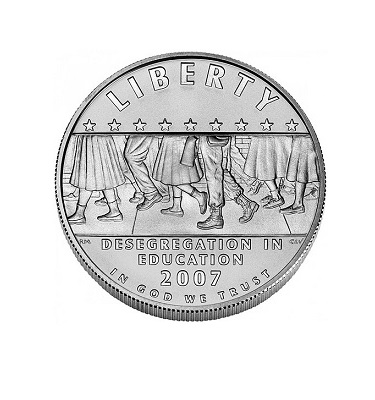
Little Rock Nine


September 24 …
The Little Rock Nine were nine African American students whose courage in integrating a previously all-white high school transformed American education and accelerated the modern Civil Rights Movement.
Their stand at Central High School in Little Rock, AR became a pivotal test of federal authority, constitutional rights, and the nation’s commitment to racial equality, leaving a lasting mark on American society, culture, and history.
The roots of the group’s opposition to discrimination can be traced back to the 1954 Supreme Court ruling in Brown v. Board of Education, which deemed racial segregation in public schools unconstitutional. In response, the Little Rock School Board implemented a gradual integration plan, and by the summer of 1957, nine students were chosen to enroll at Central High.
These students — Ernest Green, Elizabeth Eckford, Melba Pattillo Beals, Minnijean Brown, Gloria Ray Karlmark, Thelma Mothershed Wair, Jefferson Thomas, Terrence Roberts, and Carlotta Walls LaNier — were selected through the coordinated efforts of local NAACP leadership, particularly Daisy Bates, who acted as a mentor and advocate, preparing them for the hostility they would encounter, while championing the mission of peaceful compliance with federal law.
Daisy Bates also served as their primary mentor and public spokesperson during the ordeal, and her home functioned as a meeting place and strategic headquarters throughout the crisis. Her husband, L.C. Bates, was also actively involved. As co-publisher of the Arkansas State Press, he used the newspaper to advocate for school desegregation and to defend the students against segregationist attacks. While Daisy was more visibly associated with the students’ day-to-day guidance, L.C. Bates provided critical media support, political advocacy, and organizational backing.
Tensions escalated dramatically when Arkansas Governor Orval Faubus deployed the Arkansas National Guard to prevent the students from entering Central High School in September 1957 at the start of the school year. This confrontation captured national and international attention, prompting President Dwight D. Eisenhower to federalize the National Guard on September 24, 1957 and send in the 101st Airborne Division to ensure integration.
This decisive federal action highlighted the supremacy of constitutional rights over state defiance and demonstrated the rising influence of grassroots activism combined with legal advocacy. Throughout the school year, the nine students faced harassment, threats, and isolation, yet they remained steadfast, embodying a disciplined nonviolence inspired by civil rights leaders like Martin Luther King Jr.
Their determination reached a significant milestone in May 1958 when Ernest Green became the first African American to graduate from Central High School, a moment celebrated across the nation. The bravery of the Nine rallied support for stronger federal civil rights laws and energized desegregation efforts throughout the South.
In 1999, they were awarded the Congressional Gold Medal, one of the nation’s highest civilian honors, recognizing their remarkable contributions to justice and equality. Decades later, they were invited to the White House to commemorate the anniversary of their stand, affirming their vital role in the national narrative.
The legacy of the Nine extends beyond the desegregation of a single school. Their actions reshaped American education by affirming access as a constitutional right and inspired countless students, educators, and activists to confront systemic injustice.
As symbols of youthful courage and democratic ideals, the Little Rock Nine influenced public discourse, artistic expression, and historical scholarship, helping to redefine citizenship in a diverse society. With their quiet strength and collective resolve, the Little Rock Nine transformed a local struggle into a global symbol of the ongoing pursuit of racial equality in America.