

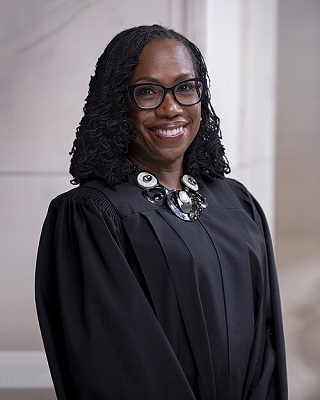
Ketanji Brown Jackson

September 14 …
Ketanji Brown Jackson is an American jurist whose historic appointment to the Supreme Court of the United States marked a transformative moment in the nation’s legal and cultural history, reflecting decades of excellence, integrity, and dedication to justice.
Listen to this story:
Born on September 14, 1970 in Washington, D.C., Jackson grew up in a family that prioritized education, civic engagement, and service. This upbringing instilled in her a deep commitment to fairness and the rule of law that would shape her extraordinary career. Her journey through the judiciary has not only enhanced access and representation at the highest levels of government, but also inspired countless Americans who see in her achievements a reflection of the country’s evolving promise.
Jackson’s academic path established a strong foundation for her legal philosophy and career. Graduating magna cum laude from Harvard College, she thrived in an environment of rigorous scholarship and diverse thought. She later earned her law degree from Harvard Law School, where she served as an editor of the prestigious Harvard Law Review.
Influential mentors during her formative years emphasized intellectual rigor, ethical clarity, and public service, equipping her to navigate complex legal landscapes and prepare for the profound responsibilities of judging with both compassion and clarity.
After law school, Jackson clerked for some of the nation’s most respected jurists, including Judge J. Michael Luttig on the U.S. Court of Appeals for the Fourth Circuit and Justice Stephen Breyer on the Supreme Court. These clerkships provided her with invaluable insights into appellate and constitutional law, connecting her with a cohort of talented legal minds.
Jackson later took on key roles in private practice, served as an assistant federal public defender, and worked at the U.S. Sentencing Commission, where she became known for her thoughtful analyses and dedication to fairness in sentencing policy. Her efforts in these positions earned her respect from peers across the ideological spectrum and highlighted her ability to bridge diverse perspectives in pursuit of equitable outcomes.
In 2013, Jackson’s judicial career advanced when she was confirmed to the U.S. District Court for the District of Columbia, presiding over significant, often high-profile cases involving national security, administrative law, and constitutional issues. Her rulings were marked by meticulous attention to precedent, clear reasoning, and unwavering emphasis on fairness.
She was subsequently elevated to the U.S. Court of Appeals for the D.C. Circuit, considered one of the nation’s most influential appellate courts. While on this bench, she continued to receive acclaim for her incisive legal analyses and collegial leadership among her peers.
Jackson made history in 2022 when President Joe Biden nominated her to the Supreme Court, making her the first Black woman — and the first former federal public defender — confirmed as a Supreme Court Justice. This landmark achievement not only broadened the representation within American jurisprudence, but also introduced fresh perspectives rooted in her extensive experience with constitutional interpretation, criminal justice, and administrative law.
Justice Jackson’s presence on the Court enriched its deliberations amidst a time of intense national debate on equity, rights, and governance. Her colleagues on the bench encompass a variety of backgrounds and judicial philosophies. Her collaborative approach has positively contributed to the Court’s mission of upholding the Constitution while addressing contemporary challenges.
Throughout her career, Justice Jackson has received numerous accolades acknowledging her contributions to law and public service, including honors from various legal organizations and civil rights groups. Beyond these awards, her most enduring legacy may lie in the doors she has opened for future generations of lawyers, judges, and public servants who see in her a model of excellence, perseverance, and integrity.
By expanding representation at the highest echelons of the judiciary, Justice Ketanji Brown Jackson has not only influenced American law, but also transformed the cultural understanding of who can serve as a guardian of justice in the United States.
